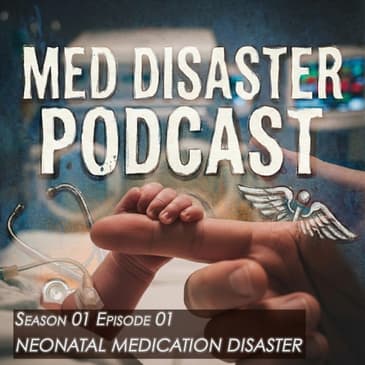
In the inaugural episode of The Med Disaster Podcast, host Dr. Sam Rhee recounts the harrowing story of how a medication error led to a massive overdose of blood thinners for actor Dennis Quaid's newborn twins, Zoe Grace and Thomas Boone Quaid. On a quiet night in November 2007, what began as a routine hospitalization for antibiotics at Cedars-Sinai Medical Center turned into a desperate fight for survival due to a heparin mix-up. The episode details the series of systemic and human errors that allowed the overdose to occur, the immediate medical response to save the twins' lives, and the subsequent changes in medical safety protocols. With insights into how such tragic errors can happen and what can be done to prevent them, this episode underscores the importance of patient safety and the continuous need for vigilance in healthcare.
TRANSCRIPT
Tragic Neonatal Medication Disaster: The Overdose of Dennis Quaid's Twins
The Med Disaster Podcast, Season One, Episode One
A Tragic Neonatal Medication Disaster
On a quiet night in November, 2007 in the neonatal intensive care unit, the NICU of Cedars-Sinai Medical Center, a pair of 11 day old twins lay in incubators, monitors beep softly, and nurses moved about under the fluorescent lights. Suddenly one nurse noticed something alarming.
Tiny Zoe Grace Quaid was oozing blood from an IV site on her arm and a spot on her heel wouldn't stop bleeding. In the adjacent bassinet, her brother Thomas Boone, also a newborn, had blood seeping from around his healing umbilical cord. This should not be happening. These premature infants were in the hospital for routine antibiotics, not a bleeding disorder.
Unbeknownst to the parents, a catastrophic medication error was unfolding.
[00:01:00] Welcome to the Med Disaster Podcast, a podcast series exploring how medical tragedies can happen and how we can help prevent them. I'm your host, Dr. Sam Rhee, and in each episode, we delve into real cases of medical problems. In this episode, we examined the catastrophic overdose of a blood thinner given to actor Dennis Quaid's infant twins. This case shook the medical community and led to significant changes in safety protocols. Our goal today is to recount what happened, to understand not only the emotional story of two babies fighting for their lives, but also the clinical details and system failures that allowed such an error to occur.
It is often said that if a tragedy like this can occur to the children of a movie star at one of the nation's top hospitals, it can happen to anyone. Unfortunately, preventable medical errors are far more common than many realize. An Institute of Medicine report estimated that as many as 44,000 to [00:02:00] 98,000 Americans die each year due to medical mistakes.
Sadly, too many of us have had our own personal experiences with medical errors, both minor and consequential, and medication errors like the one in this episode, account for thousands of those deaths annually beyond fatalities. At least 1.5 million patients are injured by medication errors in the US each year. With that perspective in mind, let's turn back to the Quaid twins and understand exactly what went wrong.
A Routine Hospitalization Takes a Terrifying Turn.
Dennis Quaid actor and star of movies, including The Right Stuff, Great Balls of Fire, Traffic, and the Rookie, and his wife Kimberly Quaid, were overjoyed when their twins, Thomas Boone and Zoe Grace were born in early November, 2007. After years of difficulty in multiple miscarriages, the couple had turned to surrogacy and their long awaited babies arrived at 36 weeks gestation, [00:03:00] slightly premature, but generally healthy.
Within a few days of bringing the newborns home, however, the Quaids noticed something concerning. Both babies showed signs of infection. Thomas developed redness and discharge around his belly button, the site of his healing umbilical cord stump, and soon Zoe also exhibited signs of infection. The pediatrician diagnosed staph infections, which are not uncommon in newborns and recommended hospital admission for intravenous or IV antibiotics. The twins were admitted to Cedars-Sinai Medical Center in Los Angeles for what was expected to be routine treatment.
IV lines were placed in their tiny arms to deliver fluids and antibiotics. As is common practice, the hospital staff used small doses of heparin and anticoagulant, which is a blood thinner to flush the IV lines and keep them from clotting off. In infants, this flush is usually a very low concentration heparin solution, often called a hep lock, [00:04:00] containing 10 units of heparin per milliliter.
Just enough to keep the IV catheter open and prevent clots, but far from a therapeutic anticoagulant dose.
By contrast, the adult strength heparin used for dissolving serious blood clots is much more potent, commonly 10,000 units per milliliter, a concentration a thousand times stronger than the pediatric flush dose. Confusing these two formulations can have devastating consequences, which is exactly what was about to happen on the twin's second day in the hospital.
That day, November 18th, 2007, started uneventfully. The Quaids spent time with their infants and were reassured that Thomas and Zoe were doing well on antibiotics. In the afternoon, the parents, exhausted from multiple sleepless nights, decided to go home to rest for a few hours.
They left strict instructions with the nurses: Call us immediately if there are any problems. Unknown to the Quaids. A string of errors was already in motion.
According to later [00:05:00] investigations, earlier that morning, the hospital pharmacy had mistakenly delivered a batch of heparin vials of the wrong concentration to the pediatric unit. Two pharmacy technicians had taken 100 vials of Heparin, 10,000. Units per milliliter, which is the adult strength from their stock and sent them to the children's ward instead of the intended 10 units per milliliter flush solution.
In essence, the NICU was now stocked with a high dose drug that had no place being near infants.
Shortly after the pharmacy delivery, the twins scheduled IV flushes were due. Nurses on the unit unwittingly used the thousand times stronger concentrated heparin to flush each twin's IV catheter.
In all likelihood, the nurses thought they were using the standard hep lock vials. The two versions of the heparin came in almost identical blue labeled vials [00:06:00] and the mixup was not obvious at a glance. No one noticed the tiny print on the label indicating the actual concentration. Critical safety steps were missed.
The nurses later could not recall whether anyone had double checked the vial label before administration. Hospital policy required an independent double check by a second licensed professional for high alert medications like heparin. But if this was done at all, it failed to catch the error tragically, both babies received not one, but two massive overdoses of heparin over the course of the day.
The first flush with the wrong concentration occurred in the morning or early afternoon. About eight hours after the first dose, the error was repeated and each twin's IV was then flushed again with 10,000 units per milliliter of heparin. Shift changes or handoffs may have occurred during this interval, meaning a second nurse may have administered the next dose also without recognizing the vial mix [00:07:00] up.
In total, each infant received two flushes with a thousand times stronger solution than intended. To put it in context, an infant of only a few kilograms received the anticoagulant dose appropriate for a full size adult being treated for serious thrombosis. The effect on the baby's blood was profound.
As Dennis Quaid later described, it was 10 units that our kid was supposed to get. They got 10,000 and it basically turned their blood into the consistency of water. They had a complete inability to clot.
In medical terms, the overdose caused an acute coagulopathy. The anticoagulant heparin in extreme excess neutralized the infant's clotting factors preventing normal blood coagulation.
The Critical Night: Signs of Disaster and Emergency Response
That evening around 9:00 PM Kimberly Quaid was at home trying to rest, but the mother [00:08:00] couldn't shake a feeling that something was wrong. In fact, as she would later recount, I just had this horrible feeling. I felt like the babies were passing.
Uneasy, Dennis decided to call the hospital to check on the twins. He reached the nurse in the NICU and asked, how are the kids? The nurse's reply was, they're fine. They're just fine. Reassured, the parents tried to sleep, completely unaware that at that very moment, their babies were in serious peril.
In reality around the time of the phone call, the NICU staff had recognized the overdose error and were scrambling in a life or death situation.
The first red flag had appeared roughly an hour or two earlier. A nurse observed uncontrolled bleeding from the baby's puncture sites where blood had been drawn and IV lines placed. Tiny Zoe was bleeding from an IV site on her arm and a heel stick wound on her foot and adhesive bandages were soaked with blood. [00:09:00] Thomas's umbilical area, which had been healing was now bleeding freely.
These signs immediately alerted the medical team that something was gravely wrong with a baby's clotting. A quick blood test would've likely shown an extremely elevated activated partial thromboplastin time known as aPTT, indicating the blood was too thin to clot.
By checking the medication records and vials on hand, the staff discovered the error. The twins had been given 10,000 units per milliliter instead of the 10 units milliliter flush. Recognizing a heparin overdose, the NICU team acted rapidly according to emergency protocol.
The priority was to reverse anticoagulation before the baby suffered internal hemorrhage, such as a brain bleed or exsanguination. They administered protamine sulfate, an antidote that binds heparin and neutralizes its effect. Protamine works quickly, but in such a massive overdose, it might need to be given in repeated small doses and [00:10:00] titrated carefully, as too much protamine can itself cause adverse reactions. The staff also likely provided supportive care, blood product transfusions to replace lost blood and clotting factors and fluid support while closely monitoring vital signs and bleeding.
According to reports, the medical team scrambled to reverse the effects of the heparin and managed to get the situation under some degree of control that night. However, the twins remained in critical condition. Their blood essentially too thin to clot, and the hours that followed were tense.
One striking moment later described by Dennis Quaid illustrates how dire the situation became as a doctor was changing a bandage on Thomas's abdomen, blood suddenly spurted from his unclotted umbilical wound, shooting five to six feet across the room and splattering on the wall. This vivid image, blood everywhere as Dennis recalled, underscores how the babies were essentially bleeding out in front of the clinicians.[00:11:00]
It is straight out of a NICU nurse's nightmare. An innocent flush of an IV line leading to a hemorrhage in a newborn.
Of note throughout this ordeal, the hospital staff did not call the Quaids to inform them of the error. It appears the team was entirely focused on managing the emergency at hand, and perhaps there was hesitation knowing the high profile nature of the patients. Consequently, the parents spent the night literally and figuratively in the dark, not learning of the crisis until they arrived at the hospital early the next morning.
Morning Revelations and Aftermath
At 6:30 AM on November 19th, Dennis and Kimberly entered the NICU expecting to find their twins recovering from nothing more serious than a minor infection. Instead, they were met at the doorway by a group of hospital personnel, the twins, pediatrician, the charge nurse, and a representative from the hospital's risk [00:12:00] management department, essentially the hospital's legal and patient safety officers.
As anyone who's worked in a hospital long enough knows, the presence of risk management was an immediate red flag, that something had gone very wrong. Inside the room, the parents were confronted with a heart wrenching sight. Their tiny infants were bruised, swollen, and covered in medical tubing and bandages with obvious signs of recent bleeding.
The babies had new IV lines, monitors attached to their frail bodies and evidence of the night's events. For example, multiple puncture wounds continued to ooze blood because clotting had been impaired. The Quaids learned to their horror that the twins had received a thousand fold dose overdose of heparin due to a medication error.
A hospital official then informed them that their children's blood had become so thin it would not clot, and an antidote had been given to counteract the drug.
Dennis later reflected, our kids could have been dying [00:13:00] and we wouldn't have been able to come down to say goodbye, a chilling thought, knowing how close they came to losing them overnight.
From that point, the Quaids could do little but watch and pray as the NICU team continued working to stabilize the infants.
The crisis persisted for approximately 41 hours during which doctors and nurses vigilantly supported the twins administering repeated doses, of antidote and closely monitoring their coagulation labs. Slowly, Zoe and Thomas' blood started to regain its normal clotting ability and the bleeding subsided.
Every few hours blood tests would check if the heparin level was coming down and clotting times were normalizing. Finally, after two harrowing days, the danger passed. The twins remained in the hospital for an extended recovery and observation, a total of 11 to 12 days in the hospital after the overdose.
But miraculously, they suffered no permanent [00:14:00] damage. At discharge, extensive evaluations showed no signs of neurologic injury or other lasting effects from the ordeal. And in late November, the Quaid family was able to take Thomas and Zoe home again, this time with a new appreciation for just how fragile life can be. Dennis Quaid would later say they were extremely lucky. Lucky that their babies survived, and lucky that they escaped the tragedy that befell other families in similar circumstances.
Indeed, as the Quaids soon learned, a nearly identical heparin error one year earlier had killed three infants in Indiana. In 2006 at Methodist Hospital in Indianapolis, six premature babies received the wrong concentration of heparin. Three of those infants did not survive the resulting hemorrhages.
The Quaid's twins narrow survival felt like a miracle. One that came with a mandate to do something to prevent this from happening [00:15:00] again.
Investigating the Error, How Did This Happen?
In the weeks following the incident, hospital administrators and state regulators launched an investigation to reconstruct how a massive error could have slipped through multiple safeguards. The California Department of Public Health conducted a detailed review since this was classified as a serious medication error causing patient harm. The findings revealed at least three critical points of failure in the medication use system at Cedars-Sinai.
Number one, pharmacy dispensing error. The wrong strength heparin was delivered to the pediatric unit.
Investigators found that pharmacy technicians had mistakenly placed 10,000 unit vials in a storage area meant for 10 unit pediatric flush vials. This mirrored the root cause of an earlier Indianapolis tragedy. Despite a prior safety alert about this risk, the separation of high concentration heparin from [00:16:00] pediatric areas was not effectively maintained.
Number two, nursing verification lapses. Multiple nursing checks failed to catch the error. The first nurse who gave the flush did not recognize that the vial was high dose heparin, likely because the packaging of the 10,000 unit and 10 unit vials looked very similar. The vials were the same size, and both had blue labels at the time, differentiated only by small print and a slightly different shade of blue.
A second nurse later repeated the dose hours later, suggesting that no one realized the mistake even after the initial administration. Cedars-Sinai policy required an independent double check, two licensed professionals verifying the medication and dose for high alert drugs like heparin. If this double check occurred, it was not truly independent or careful, likely due to confirmation bias where both nurses assumed they had the standard flush and saw [00:17:00] what they expected to see.
In fact, the nurses involved told inspectors they could not remember whether they had read the label on the heparin vials at all.
Number three, system alert failures. The hospital did not have effective system level alerts in place. For example, barcode medication scanning where nurses scan the drug and patient bracelet to verify correctness was not either yet fully implemented in that unit or not utilized. Barcoding was becoming standard in hospitals by 2007 after FDA regulations mandated barcodes on all medications, but not all units nationwide were equipped or consistent in using them.
Additionally, no computerized dose check flagged the overdose. Flush orders for heparin were likely entered for 10 units, but since nurses obtained the drug from floor stock, the electronic system may not have had a way to verify the correct concentration when selected manually.
[00:18:00] In essence, the safety net had holes. It relied on humans to perform checks that under the pressures of a busy ICU were missed.
The CEO of Cedars-Sinai, Thomas Priselac acknowledged that this was a preventable error resulting from human mistakes. This was a classic Swiss cheese situation: multiple layers of defense were in place, but the holes in each layer: labeling confusion, stock mix ups, lapse in double check, lack of automated verification all aligned to allow the error to reach patients.
It's important to understand that no single individual was solely at fault. Rather, this was a system failure. The nurses and pharmacy techs involved were devastated by the incident. In a culture of safety, the focus shifts from blaming individuals to improving the system to prevent future errors, and that's exactly what happened next.
Heparin is [00:19:00] classified as a high alert medication, meaning that mistakes involving heparin are much more likely to cause significant harm or death. In fact, heparin consistently ranks among the top 10 drugs involved in serious medication errors along with insulin, potassium chloride, morphine, and warfarin, also known as Coumadin.
Labeling and packaging issues have historically contributed to issues. Prior to 2008, the pediatric heparin vials, the 10 units and the adult vials, 10,000 units from Baxter Healthcare looked disturbingly alike, and this was a known hazard. In fact, after the 2006 Indianapolis fatalities, Baxter and the FDA issued a nationwide alert highlighting the potential for fatal mixups due to the vials similar appearance. Baxter had announced it would redesign its labels changing the high dose vial label color from blue to black, enlarging the font, and adding a prominent red alert symbol [00:20:00] on the 10,000 unit vials.
These vials started shipping October, 2007. However, the critical gap was that Baxter did not recall the old stock still sitting on hospital shelves. Cedars-Sinai, like many hospitals, was still likely using up its inventory of old labeled vials.
The Quaid twins, thus fell victim to a known issue in the interim period. Dennis Quaid later criticized this, pointing out that companies will recall faulty toasters and toys, but they don't recall medicine that kills people if you give it the wrong dosage. Baxter's stance was that the product itself was not defective, and it was the responsibility on healthcare providers to read the label each time.
A Baxter representative stated one of the most important components of medication administration is to read the label and not rely on color, shape, or size of the vial. And in truth, both are correct. Manufacturers must design safer packaging [00:21:00] and clinicians must rigorously follow medication verification protocols.
Patient safety experts often emphasize the multiple redundant checks, especially for high alert drugs.
System Reforms and Safety Improvements
The hospital was found to be an immediate jeopardy of patient safety by state authorities, which can carry serious penalties. And Cedars-Sinai responded with immediate fixes and longer term changes.
Cedars removed all heparin vials intended for IV flushes from pediatric care and switched to saline or salt water flushes for maintaining IV lines in both pediatric and adult units.
If an anticoagulant is absolutely needed to keep a specific line open such as central lines, it would be prepared in the pharmacy in a controlled manner rather than kept on the floor as stock.
Cedars-Sinai also required all 1800 nurses and 200 pharmacy staff to undergo refresher training on medication administration [00:22:00] safety. This included reemphasizing the five rights of medication, right patient, right drug, right dose, right route and right time.
Around this time, Cedars-Sinai and many other hospitals accelerated the adoption of barcoded medication administration systems. Each unit dose medication has a barcode and the patient's wristband has a barcode.
Scanning both with a handheld device or computer ensures that the medication and dose match what is ordered for the patient. One study in the early two thousands found that barcoding could eliminate an estimated 60 to 80% of medication orders in hospitals.
This case also raised questions about transparency and communication. Cedars-Sinai faced criticism for not informing the parents immediately when the error was discovered. In the aftermath, hospitals have increasingly recognized that patients and parents must be promptly informed about any significant adverse event.
This is both an [00:23:00] ethical obligation and in many regions a legal one. While this is not a systems fix, per se for preventing the error, honest communication is vital for maintaining trust and learning from mistakes. Cedars-Sinai indicated it would address any internal missteps in communication and ensure families are partners in care even when crises occur.
Lessons and Reflections
For Dennis and Kimberly Quaid this experience was life changing. Dennis Quaid has said not a day goes by he doesn't think about how close they came to losing their children, and he no longer takes any day for granted. The couple turned their ordeal into advocacy. They established the Quaid Foundation, a nonprofit organization focused on patient safety initiatives.
Dennis Quaid even testified before Congress in 2008 using his family's story to illustrate the urgency of [00:24:00] reducing medical errors. He became a vocal proponent of barcoding systems and stricter protocols, essentially lending his celebrity voice to amplify what healthcare experts had been saying: that preventable medical errors are a public health crisis that deserves the same attention as diseases like cancer or AIDS.
As Quaid pointed out in interviews, tens of thousands of Americans die each year for medical mistakes. It's bigger than AIDS, bigger than breast cancer, bigger than automobile accidents. Yet historically, it hasn't received commensurate public attention. In the months and years after the twins overdose, the Quaids saw concrete changes: new heparin labels, new protocols, a new spike in awareness.
Yet serious medication errors did not vanish overnight. In fact, shockingly a year later in 2008 a hospital in Corpus Christi, Texas mistakenly gave heparin overdoses to 14 infants, two of whom had died. [00:25:00] And so the effort to improve medication safety continues to this day. Each tragedy or near tragedy serves as a painful reminder of the work yet to be done.
For clinicians, the Quaid Twins case reinforces that patient safety requires constant vigilance and a commitment to systemic improvement. It's a call to action to never become complacent, to treat every medication with respect to double check, even if you're sure, and to speak up if something doesn't seem right.
These infants survived because dedicated professionals acted quickly when the error came to light and because luck was on their side. Our job in healthcare is to design systems so effective that patient safety isn't left to luck.
We can now reflect on Zoe and Thomas, now healthy teenagers, and the legacy their story has in driving safer practices. Their ordeal has likely prevented countless other errors by spurring change in hospitals around the [00:26:00] world. In the words of Albert Wu, a patient safety expert, healthcare is just beginning to realize how big a problem it has with patient safety, and until it does, these incidents will keep happening.
The case of the Quaid Twins was a catalyst for that realization. May we honor it by continuing to learn and improve.
Thank you for listening to this episode of the Med Disaster Podcast. I'm Dr. Sam Rhee, and we'd like to hear from you. Please reach out on Instagram @med.disaster or sign up for our newsletter at www.meddisaster.com. Thank you.