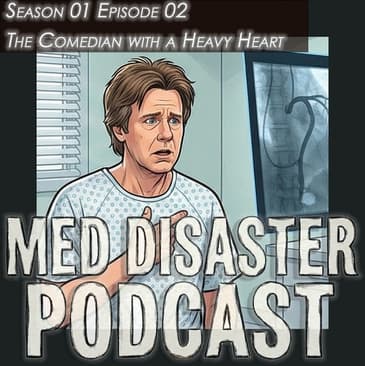
In this episode of the Med Disaster Podcast, we explore the harrowing true story of comedian Dana Carvey's heart surgery gone wrong. Carvey, known for his roles on Saturday Night Live, faced a severe cardiac condition that led to a heart bypass surgery where a critical error occurred. The surgeon bypassed the wrong artery, leaving Carvey with the same life-threatening blockage. This episode delves into the sequence of errors, the aftermath for Carvey and the healthcare system, and the lessons about surgical safety and patient care that emerged from this shocking case. Through detailed recounting and analysis, listeners will understand how such a catastrophic mistake is possible and how it could have been prevented.
#MedicalMalpractice #PatientSafety #DanaCarvey #TrueMedicine #SurgicalError #HeartHealth #NeverEvent #PatientAdvocacy #MedicalPodcast #BotchedSurgery
TRANSCRIPT
S01E02 The Heartbreaking Story of Dana Carvey's Surgical Misfortune
[00:00:00]
I am Dr. Sam Rhee, host of the Med Disaster Podcast, and in today's episode we have a case that reads like a plot from a dark comedy, except it's entirely true. It involves a famous comedian, a life-threatening heart condition, and a shocking surgical mistake.
This is the story of how Saturday night alum Dana Carvey underwent heart bypass surgery for a blocked artery only to discover afterward that the surgeon had bypassed the wrong artery. It sounds unbelievable. Almost like the punchline to a joke, the surgeon operated on the wrong artery.
But for Dana Carvey, this was no laughing matter. How could a mix up occur in a modern operating room? What cascade of errors and oversights led to this outcome and what happened in the aftermath for the patient, the surgeon, and the healthcare system? In this episode, we'll delve into the full story of this extraordinary [00:01:00] case.
We'll explore Carvey's heart disease journey, the rationale for his bypass surgery and the breakdowns in procedure and communication that allowed a critical mistake to slip through. Along the way we'll hear in Carvey's own words how he coped with the ordeal, and will also comment on the surgical protocols and safety practices relevant to this case.
And finally we'll discuss the malpractice lawsuit, the hospital's response, and the lessons this case imparted. Lessons about surgical teamwork, patient autonomy, and preventing errors.
The comedian with a heavy heart: Dana Carvey's cardiac history.
It is the late 1990s. Dana Carvey is known to America as a brilliant comedic performer, the man behind SNL characters like the church lady and Garth from Wayne's World offscreen. However, Carvey is facing a very unfunny health crisis at just 42 years old.
He experiences recurring chest pains and even a heart [00:02:00] attack at one point, The diagnosis, significant coronary artery disease. Carvey has a strong family history of high cholesterol and heart problems. In fact, his total cholesterol had soared to over 400, far above the desirable range below 200. Combine genetics with the stress of a high profile career in show business, and Carvey found himself with burning chest pains and episodes of angina, which is heart muscle pain due to restricted blood flow by the mid 1990s.
Clinically, Carvey's condition was serious, but not uncommon. One of his coronary arteries, the left anterior descending, or LAD artery, had a significant blockage. The LAD is a critical vessel, often nicknamed the widow maker when severely obstructed, because a blockage there can cause a massive heart attack. To restore blood flow, Carvey initially underwent angioplasty, a catheter-based procedure where a small balloon is inflated inside the blocked artery to reopen it, [00:03:00] often followed by placing a stent, a tiny metal mesh scaffold to keep the artery open.
Over the course of 1997, Carvey had not had one or two, but he had three angioplasty and stent procedures on the LAD. And each time the artery would renarrow in a process called re-stenosis and the chest pain would return in months.
At that time when bare metal stents were used before the newer drug eluding stents were available, re-stenosis was a frequent frustration because scar tissue would grow along the stented segment and reclog the artery. Despite multiple interventions, Carvey's angina kept coming back.
By early 1998 Carvey and his doctors realized that another approach was needed. His Los Angeles based cardiologist, Prediman K. or PK Shaw at Cedar-Sinai advised that if the LAD blockage recurred yet again, the best option would be coronary artery bypass graft surgery, or a CABG.
Okay. CABG is an open heart [00:04:00] surgery that creates a new route for blood to flow around a blocked artery. In a bypass, a surgeon takes a healthy blood vessel, often the internal mammary artery from the chest, or a vein from the leg and grafts it onto the coronary circulation, effectively bridging past the blocked section of the artery.
Carvey ever the jokester later equipped, he thought of it as a quote, advanced plumbing problem. They bypass a bad section of rotted out pipe and reconnect using the good sections, and it's an accurate layman's description of what a bypass does: provides a detour for blood like rerouting traffic around a closed highway.
Still the idea of open heart surgery was daunting for the 42-year-old comedian. This was a man whose job is to make people laugh, and he was facing one of the most serious surgeries in medicine. Carvey tried to keep his spirits up with humor and on the gurney headed to the OR, he jokingly did a Woody Allen impression, and mused, maybe I could, you know, just take an aspirin. Make sure the knife is sharp, he recalls.
But behind the [00:05:00] jokes was very real apprehension as he testified later he told himself, let's bite the bullet and do this horrific open heart surgery thing so I can get on with my life and my career.
In March, 1998, Dana Carvey finally agreed to undergo a double coronary artery bypass operation. This meant surgeons would create two separate bypass grafts to detour blood around two blocked segments in his coronary arteries. Carvey's primary issue was the LAD lesion, but since he had another significant blockage in a different artery, there was a need for a second bypass graft.
Often in a double bypass, it might be the LAD plus the right coronary or a branch of the circumflex artery. The specifics in this case were not heavily publicized, but we do know two graft were planned. Importantly, Carvey decided to have the surgery done near his home in Northern California at Marin General Hospital for convenience and on the advice of his local physician, Dr. Elias Hanna, a veteran cardiac [00:06:00] surgeon from the San Francisco Bay Area who would be performing the operation. Carvey's trusted cardiologist, Dr. PK Shaw had urged him to consider coming to Los Angeles for the surgery even suggesting a private plane trip. But Carvey's local doctors felt it was safer not to fly, given his condition, and in the end, Carvey chose the surgeon and hospital closer to home.
It was a choice he hoped would make a scary process a little bit easier, but little did anyone know how critical that choice and what followed would become.
Before we move on, let's touch on the standard precautions and planning that go into a coronary bypass surgery. By the late 1990s, CABG was a routine procedure. In terms of frequency. Tens of thousands are done every year, but it's never minor.
The surgical team normally conducts extensive preoperative imaging studies to map out the patient's coronary anatomy. Coronary angiography, an x-ray movie of the heart's arteries using injected dye, is the gold standard for pinpointing blockages. Carvey had multiple [00:07:00] angiograms during his treatment, one with each angioplasty and another in preparation for surgery. So by the time of the bypass, the surgical team had known exactly which artery segments were diseased and needed bypassing.
Typically the cardiologist angiography report guides the surgeon. For example, 90% proximal, LAD stenosis would indicate the LAD near the origin is severely narrowed. So a graft from the aorta or internal mammary artery should be attached to the LAD beyond that blockage. Surgeons will often mark or make mental notes of these target sites.
But unlike a surgery on a limb, you literally can't mark an artery on a heart surface beforehand. It requires intraoperative identification. Surgeons rely on the anatomical landmarks of the heart, the preoperative imaging, and sometimes palpation or touching the coronary arteries where you feel for pulses or the hardness of a blockage to locate the correct spot to attach the graft.
In Carvey's case, Dr. Hanna had performed tens of thousands of bypass operations in his career, [00:08:00] and by all accounts, this should have been a routine double bypass for an experienced surgeon. On the day of the procedure, Carvey was prepped, anesthetized, and put on cardiopulmonary bypass, which is the heart lung machine as a standard for traditional CABG surgery.
Dr. Hanna harvested the left internal mammary artery known as the LIMA from inside Carvey's chest wall, and this artery is a common graft choice, especially for the LAD because it has excellent long-term patency. He also likely took a segment of saphenous vein from car's leg for the second graft.
Then with Carvey's heart temporarily stopped and the blood circulation maintained by the machine, the surgeon began attaching the grafts to bypass the clogged vessels.
What should have happened is that one end of the LIMA graft would be sewn into the LAD, just beyond the blockage, effectively providing a new route for the blood from the subclavian artery via the LIMA into the LAD, past the obstruction.
The other graft, the saphenous vein would be attached to [00:09:00] whatever artery needed bypass. For example, the right coronary artery, if it was part of the plan. And the key is identifying the correct target artery on the surface of the heart.
The LAD runs down the front of the heart, usually fairly prominent with diagonal branches coming off at angles. Sometimes, however, patients do have anatomic quirks. An artery might be buried within the heart muscle called an intro myocardial course instead of running on the surface where it's easily seen.
According to Dr. Hanna's defense later, Dana Carvey had unusual anatomy where the artery was embedded in the heart muscle and not easily visible. In other words, the surgeon claimed that Carvey's LAD was hidden from view, making it hard to be sure where to attach the graft.
Whether the anatomy was truly unusual became a point of contention, and we'll explore that later. But in the OR, Dr. Hanna proceeded as best as he could. He attached the LIMA graft to what he believed was the correct artery. And after [00:10:00] completing the two grafts, Carvey was taken off the heart lung machine.
His heart resumed beating and the chest was closed up. The immediate postoperative course appeared uneventful. The surgical team likely believed the bypass was successful. Carvey was extubated, which means being taken off the ventilator, being moved to the ICU and then recovering on the cardiac step down unit for several days.
Within a week, he was discharged home from the hospital, hopeful that his heart woes were finally behind him. Okay. At first all signs were positive. The relief and happiness Carvey felt after surviving open heart surgery was immense. I was euphoric when I went home believing that the potentially life-threatening blockage was finally cleared. Carvey later said.
For a brief time, it seemed like a happy ending. The famous, funny man had faced down heart disease with a quadruple dose of courage and humor, and now he could get back to life and laughter. Unfortunately, within weeks, Dana Carvey realized [00:11:00] something was very wrong.
Deja vu: the same chest pain returns.
Imagine surviving a major surgery and thinking you're cured only to have the original symptoms come creeping back.
That's exactly what happened. Not long after the bypass, Carvey started feeling that familiar burning chest pain again when he had exerted himself walking up hills or climbing stairs triggered the ache just as it did before.
At first, this might have been attributed to postoperative healing. It's true that after a bypass, patients can have chest discomfort from the sternotomy, which is the chest bone incision, and from the heart regaining normal function. Dr. Hanna reportedly assured carv that his pain was just a normal postoperative effect of the surgery.
Nothing to worry about. And for a short time, Carvey tried to believe that, but as the weeks went by, the chest pain did not improve. In fact, it persisted [00:12:00] alarmingly like the angina he had before surgery. Carvey knew his body and he grew concerned that we were back to square one again as he later described it.
Two months post-op, in May of 1998, he decided to seek a second opinion. He contacted his LA cardiologist, Dr. Shaw and his colleagues who arranged for diagnostic tests to investigate why Carvey was still having angina.
They wasted no time in performing a follow-up angiogram. And what that angiogram revealed was jaw dropping. The critical blockage in Carvey's coronary artery had never been bypassed at all.
One of the new graft, specifically the internal mammary artery graft, was attached to the wrong artery, meaning it was delivering blood to a vessel that did not even need it. While the truly blocked artery, the LAD remained clogged and uncorrected.
In surgical terms, Dr. Hanna had connected the healthy graft to a healthy diagonal branch instead of to the actually diseased LAD. The bypass had bypassed [00:13:00] nothing and Carvey's main coronary artery blockage was still there, festering like a ticking time bomb.
The news was almost too absurd to believe. Upon hearing the results, Carvey initially thought there must have been some mistake or even a dark joke. They bypassed the wrong artery, the diagnosing cardiologist, Dr. Neil Eigler, told him bluntly, Carvey known for his comic skepticism, recalls replying. Huh, you're hilarious, but let me be the comedian. Seriously, doctor, what happened?
And the doctor repeated gravely. They bypassed the wrong artery. There was no misunderstanding. It was literally that straightforward and that horrifying.
Carvey was stunned. I remember just lying in my bed, just sobbing. He later told a courtroom. I can't believe they connected it to the wrong artery.
It was a mix of shock, betrayal, and dread. In an instant, the confidence that he'd had in his surgery evaporated all the pain and risk he [00:14:00] endured, had been for naught, and he still had a life threatening blockage in his heart. Even the ever jovial Carvey likened the error to a nightmare scenario. He likened it to removing a wrong kidney.
It's that big of a mistake, he says The gravity of it hit him hard.
A surgeon operating on the wrong site, essentially a wrong side surgery inside the chest is one of medicine's most egregious errors typically termed a never event because it's never supposed to happen.
For Carvey, beyond the emotional toll, there was an immediate, practical concern.
What now? The blocked LAD was still there, threatening his heart muscle each day. His LA doctors were appalled and quickly moved to fix the problem as safely as possible. The choice came down to either doing another open heart surgery to correctly bypass the LAD or attempting another less invasive intervention.
Understandably, Carvey was absolutely terrified at the thought of undergoing another open heart surgery so soon. [00:15:00] Fortunately, the cardiologist determined they could try one more angioplasty, this now being the fourth one on the same LAD to open that blockage, sparing him a redo bypass if it succeeded. And in May of 1998, roughly two months after his botched surgery, Carvey had that emergency angioplasty performed by Dr. Shaw's team in LA. They inserted another stent to clear the clogged LAD, and this time it worked. The stent held the artery open and restored blood flow where the bypass graft had failed to do so, and in fact, that final stent has kept that LAD open for over 15 years now without further issues.
It is important to highlight how fortunate Carvey was in this misfortune. Despite months of inadequate blood flow before and after the surgery, his heart muscle never suffered a major infarction or heart attack or permanent damage. Dana was very fortunate, despite all he had gone through, Dr. Shaw noted, adding that Carvey had absolutely no damage to the heart muscle itself, and that he could return to full activity after recovery.[00:16:00]
This outcome is far better than many in similar circumstances, and some patients might have had a heart attack during the interim or deteriorated rapidly. Cavey's own quip was now, he could do anything he wishes except eat double cheeseburgers with mayonnaise, poking fun at the lifestyle changes that come with being a cardiac patient.
Still at that time, Carvey faced a long road of recovery ahead. After the emergency angioplasty, he had to convalesce for another six months to regain his strength.
Initially only able to work a few days during standup and forced to cancel or turn down a string of professional engagements. By his own estimate, Carvey lost nearly $7 million in income due to the prolonged illness and recovery. This included missed opportunities like TV shows, commercials, and a gig on Hollywood Squares.
Financial loss aside, the psychological impact was profound. Carvey said he often worried about his family and whether he'd be around for them. It's a heavy burden that no patient should have to bear, and it was caused not by bad [00:17:00] luck or a rare complication, but by human error in an operating room.
How could this happen: dissecting the surgical error?
At this point, you might be asking, how on earth does a surgeon bypass the wrong artery? It isn't a mix up say, of operating on the wrong limb where maybe a marking was missed. This is deep inside the heart, presumably under direct visualization.
The answer lies in a combination of anatomical anomaly, intraoperative confusion, and a breakdown in the usual verification process. Let's break down the factors that contributed to this mistake.
Number one, unusual coronary anatomy. Dr. Hanna's defense hinged on the claim that Carvey's LAD had an atypical location.
Specifically, it was running within the heart muscle rather than on the surface where it's normally visible. This could indeed make the LAD harder to identify during surgery, although this could indeed make the LAD harder to identify during [00:18:00] surgery.
Additionally, Carvey's LAD apparently gave off a diagonal branch near the area of the blockage. And the surgeon mistakenly attached the LIMA graft to the diagonal branch instead of the LAD itself.
In Carvey's case, that diagonal branch or side road was healthy and didn't need the bypass. The main highway, the LAD was the one clogged and in need of grafting. If the LAD was hidden and the diagonal branch was more visible, one can envision how a surgeon might confuse the two.
Notably, expert cardiac surgeons have commented that while such an anomaly can occur in five to 10% of patients, a careful surgeon should be able to identify the correct artery and do the bypass even in those cases. In other words, unusual anatomy might be a contributing factor, but it shouldn't be an excuse.
In fact, Carvey's cardiologist later countered that his anatomy was actually pretty ordinary and not nearly as unusual as claimed.
This suggests that what was characterized as an anatomic quirk might simply have been a surgeon's error in [00:19:00] orientation or judgment.
We may never know the exact visual context Dr. Hanna saw, but clearly he was confident enough at the time that he was in the right spot, but he was wrong.
Number two, lack of intraoperative verification In 1998, it was not routine for surgeons to perform an on table angiogram or advanced imaging to verify that the graft replaced correctly before closing up the chest.
The standard practice was and still often is to rely on visual confirmation and experience. If a graft has a good pulse and bleeding is controlled, the surgeon assumes it's in the right place in functioning. Today, some centers do use techniques such as intraoperative flow measurements or fluorescent angiography to double check graft patency and location before finishing the surgery.
Today. Some centers do use techniques such as intraoperative flow measurements or fluorescent angiography to double check graft patency and location before finishing the surgery. These tools, for example, injecting a dye and using an infrared camera to see blood flow through the [00:20:00] graft can sometimes catch a mistake such as a mis-attached graft.
Had such technology or techniques been used in Carvey's case, the team might have noticed that blood flow was going to a region of the heart that had already had good flow while the LAD remained unperfused. But back then, such checks were uncommon, and instead, the first sign of problems were the postoperative symptoms.
Number three, communication and team dynamics. A surgical mishap of this magnitude often indicates a breakdown in usual team communication or protocols in the operating room. Ideally, there's a culture where any team member, a nurse, a surgical assistant, and an anesthesiologist can speak up if something seems amiss.
However, identifying the correct coronary artery is a task that really falls to the lead surgeon's judgment and skill. Junior staff and nurses wouldn't necessarily know if the wrong artery was being grafted because it's a very technical distinction here. The only person with the knowledge and vantage point to recognize the mix up in real time was Dr. Hanna himself.
We don't know if he had any moment of doubt or confusion [00:21:00] during the bypass and it's possible he only realized the error when confronted later, or perhaps he never realized it until the angiogram by others revealed it.
What we do know is that after the surgery, when Carvey reported ongoing pain, the surgeon attributed it to normal healing rather than investigating further. And this is a subtle but important point, listening to the patient and taking their concern seriously as a form of communication that can catch problems.
If a patient continues to have ongoing angina like pain after a bypass, a reasonable step might be to do tests such as a stress test or angiogram to ensure the grafts are open.
Dr. Hanna's continued reassurance delayed the discovery, and it was only Carvey's persistence in seeking a second opinion that ultimately brought the truth to light.
Number four, system level protocols in terms of systemic safeguards. This case happened before a major shift in patient safety practices. In 1999, the Institute of Medicine's Landmark Report to Err is Human was published highlighting that tens of thousands of Americans die from medical errors [00:22:00] each year.
And in the early two thousands, hospitals and regulators began instituting universal protocol for surgery, including the now standard timeout, before incision to verify a correct patient procedure and site.
In this particular procedure, everyone would know what the correct procedure was, a double CABG. And so a timeout would have confirmed that plan, but would not have prevented an error in executing that plan.
However, one possible system improvement would have been better preoperative documentation of unusual anatomy. If the preoperative angiogram suggested the LAD was intramuscular or hard to see, that could have been clearly communicated to the surgeon and even noted on the surgical plan. So extra care such as using an intraoperative ultrasound probe or dye test could have been taken.
Another systemic approach is encouraging surgeons, no matter how experienced, to take a brief pause if the anatomy isn't matching expectation and even consult a colleague intraoperatively. We don't know if Dr. Hanna considered the anatomy unusual during the operation or [00:23:00] if he was struggling, and if so, he might've felt pressured to complete the case himself.
Surgeon psychology, pride, confidence, reluctance to admit uncertainty can sometimes, unfortunately play a role in errors.
Now, one might argue Dr. Hanna was extremely experienced and he did not intend to harm clearly. Indeed, his attorney characterized the incident as an honest mistake made by a surgeon who had done 30,000 bypasses successfully, and that may well be true.
Even the best surgeons are human and can slip up. But from Carvey's perspective and that of his medical team in LA, this error went beyond a benign, oops. They were far. They referred to it as a goof up and even gross negligence. Why negligence? Because a reasonably careful surgeon should not bypass the wrong artery, even if the patient's anatomy is slightly unusual.
It is worth noting that bypassing a wrong artery is virtually the cardiac surgery equivalent of operating on the wrong body part. It's a never event by patient safety [00:24:00] standards.
The aftermath: accountability, apologies, and a lawsuit
Dana Carvey could have simply thanked his lucky stars that the error was fixed and moved on. After all, he had survived the ordeal and regained his health by late 1998, and by the following year, he was back to performing, even guest hosting for David Letterman show.
While Letterman was out for his own heart surgery, Carvey's cholesterol was under control, dropping from 400 to 150 with medication and diet, and he made a full recovery physically. But Carvey felt compelled to take action, not for revenge, but for accountability. And in 1999, roughly a year after the botched surgery, Dana Carvey filed a medical malpractice lawsuit against Dr. Elias Hanna and the hospital. He sought 7.5 million in damages corresponding largely to his lost earnings and pain and suffering for that last year. From the outset, Carvey was adamant that this lawsuit from the beginning was about accountability and doing everything I could to make sure it [00:25:00] wouldn't happen to someone else.
It was not, he said, primarily about the money. In fact, he and his wife promised that any settlement or award would go mostly to charity, specifically toward cardiac research and charities rather than their own pockets. His own true motivation, he explained, came from a sense of right and wrong and he felt an error of this magnitude needed to be acknowledged and learned from.
And importantly, he said he wouldn't have gone to court if it had simply received something very simple early on. An apology. This is an interesting aspect of this story. Carvey had recounted that after the mistake was discovered, no one from Dr. Hanna's team or the hospital ever apologized or even directly informed him of the error. There was no letter of apology or explanation, no phone call. He said he was left to find out through his own doctors that something had gone terribly wrong, and later during legal depositions, Dr. Hanna apparently denied making a mistake at all, maintaining he did nothing wrong, a stance that deeply frustrated Carvey. In a [00:26:00] television interview, Carvey explained it was only because in the deposition he said, I didn't make a mistake. Total, you know, denial, so I had to sue.
This aligns with what many patients feel in the aftermath of medical errors. What they most want is honesty. An apology, an insurance, an assurance it won't happen again. When those needs are met with silence or denial, anger and revenge can drive them to litigation.
In Carvey's words, I felt this was a matter of right and wrong. I wanted to be satisfied that the surgeon would not be hurting someone else and would acknowledge his error. The lawsuit played out in San Francisco's Superior Court in May 2000. About two years after the surgery, Carvey took the stand and he recounted the whole ordeal to the jury.
In an unusually serious demeanor for a comedian, jurors listened as he described, the physical pain, the mental anguish, and the moment of devastation when he learned of the surgical blunder.
He brought humor to the stand [00:27:00] occasionally. He also brought humor to the stand occasionally. For instance, describing how he kept pressing the morphine PCA pump post-op until it would run out because of the pain, eliciting chuckles from the courtroom.
But overall, it was a somber and riveting testimony from someone known for levity. The trial also featured testimony from medical experts. The defense repeated the claim of Carvey's unusual anatomy causing a mishap, and it's worth noting that Carvey himself didn't require another open heart surgery in the end, thankfully.
So the direct physical harm was limited to the pain and the risk of an extra angioplasty and months of disability. Some observers might wonder if that mitigated the damage. However, Carvey's, lawyers argued the emotional toll and the loss of productive time were substantial harms in and of themselves and Carvey's six month recovery and his curtailed career opportunities were laid out as real damages, along with the ordeal that he and his family endured, not knowing if he'd need another major surgery. Midway through the trial after Carvey's testimony had made headlines, the [00:28:00] story was covered widely in the media from People Magazine to Entertainment Tonight, an outcome was reached and in May 2000, Dana Carvey and Dr. Hanna's legal team agreed to an out of court settlement for an undisclosed sum. The amount was confidential, but Carvey reiterated that the majority of it would go to charity as he had promised in a statement after settling. Carvey expressed that he and his wife were very satisfied with the outcome and bringing resolution to the case. And he emphasized again that his aim was to ensure something positive came from the incident: primarily steps would be taken so a mistake like this would not happen to someone else.
Dr. Hanna for his part never publicly admitted fault as far as records show and the hospital Marin General did not issue any public grand statements beyond the defense that had been presented.
It is likely that the case was an embarrassment for the surgical team and one hopes it prompted introspection and improvements on how such surgeries are approached, but those details remain behind closed doors.
What Carvey's case [00:29:00] did do on a broader scale was contribute to the national conversation about medical errors and how doctors and hospitals respond to them. And in the early two thousands adopted policies of full disclosure and a policy spurred by evidence that it actually leads to lower litigation cost and improves patient satisfaction when providers actually admit mistakes and apologize.
In a Los Angeles Times article in 2003, Carvey's situation was highlighted as an example, how not to handle an error: the surgeon's total denial versus the patient's need for an apology.
The article's takeaway was clear. Had there been an apology and an honest discussion. Carvey might not have felt the need to press a lawsuit at all. This aligns with some research showing patients may not sue primarily for money, but because they feel angry or stonewalled when doctors won't tell them what happened or assume responsibility.
In the years after Carvey was honored by the American College of Cardiology for his advocacy of early detection and prevention of heart disease. And in interviews, he has shared heart [00:30:00] health tips and the importance of knowing one's risk, factors, turning his personal ordeal into a teachable moment for others.
Key takeaways and lesson learned.
The story of a wrong artery bypass is obviously dramatic and fortunately rare. Let's summarize some key takeaways.
Number one, even highly skilled surgeons are fallible. One lapse, whether due to overconfidence, a moment of misidentification or cognitive bias can lead to a serious error.
And this underscores that no provider is infallible in surgical practice. That means using all available tools for critical verification when possible.
Number two, an honest mistake versus accountability. What might seem to a surgeon, like an honest mistake, can appear to a patient as negligence or arrogance if not handled properly.
In Carvey's case, the initial refusal to acknowledge a mistake, compounded Carvey's distress, and virtually invited legal action.
As one analysis put it, [00:31:00] patients generally seek three things after an error: explanation apology and assurance. Healthcare providers and systems must strive to deliver those.
Dana Carvey's ordeal was a convergence of high stakes medicine and human error experienced by a man more accustomed to making jokes than being the subject of an ICU scene. And it highlights that in healthcare, even one misstep on a single case can reverberate through a patient's life, a provider's career, and even the media landscape potentially catalyzing change today, Carvey is healthy and back to comedy, and Dr. Hanna continues practicing with one hopes, a lesson indelibly learned. And the case reminds us that behind every medical error statistic is a real person. And that by examining these mistakes openly, we can find ways to improve.
Surgical safety like comedy often relies on timing, teamwork and not missing the cues. The stakes however, are life and death and not laughs. Thank you for listening to this [00:32:00] episode of the Med Disaster Podcast. I'm Dr. Sam Rhee, and we'd like to hear from you. Please reach out on Instagram @MedDisaster or sign up for more exclusive free content at www.meddisaster.com.
Until our next episode, please stay vigilant. And stay compassionate.