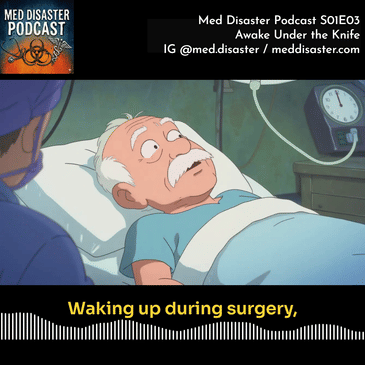
S01E03 Awake Under the Knife: The Tragic Case of Sherman Sizemore
In this episode of the Med Disaster Podcast, Dr. Sam Rhee discusses the harrowing case of Sherman Sizemore, a 73-year-old Baptist minister who experienced intraoperative awareness during surgery in 2006. The episode delves into the medical and procedural failures that led to this catastrophic incident, examining the anesthesia process, the critical errors made, and the profound psychological and legal aftermath. The discussion also explores broader implications for anesthesia safety, informed consent, and preventive measures to avoid such tragedies in the future.
#MedicalErrors #AnesthesiaAwareness #TrueCrime #HealthcareSafety #MentalHealthMatters #PatientAdvocacy #MedicalPodcast #SurgicalSafety #Healthcare
S01E03 Awake Under the Knife: The Sherman Sizemore Case
[00:00:00]
Med Disaster Podcast, Season One, Episode Three. Awake Under the Knife, The Case of Intraoperative Awareness.
Welcome to the Med Disaster Podcast, where we unravel real medical errors to understand what went wrong and how we can prevent it from happening again. I'm Dr. Sam Rhee, your host.
Today we delve into a chilling case that underscores the critical importance of vigilance in anesthesia. The story of Sherman Sizemore, a 73-year-old Baptist minister who experienced the unthinkable waking up during surgery, completely paralyzed and unable to scream for help.
This 2006 incident of intraoperative awareness had tragic consequences, including profound psychological trauma resulting in a terrible tragedy. In this episode, we will walk through the event in chronologic order, examine the clinical procedures and pharmacology of anesthesia, and analyze [00:01:00] the system failures that led to a patient being awake under paralysis.
We'll discuss Sherman's size, Moore's medical history and surgery, what went wrong with the anesthesia, induction and maintenance, and the aftermath medically, psychologically, and legally. And finally, we'll explore the broader implications for anesthesia safety informed consent, and perioperative protocols that arose from this haunting case.
The Devout Patient Who Needed to Undergo Surgery
Sherman Sizemore Jr. was a 73-year-old Baptist minister from Beckley, West Virginia, and a retired coal miner. By all accounts, he was a healthy, older gentleman with no history of psychologic illness, and in early January, 2006, he began suffering from recurring unexplained abdominal pain.
Despite initial evaluations, the cause for his pain remained unclear and his doctors recommended an exploratory laparotomy, which is an open abdominal surgery to diagnose and [00:02:00] potentially treat the source of his pain. In fact, his family later indicated that gallbladder problems were suspected as a culprit, which is why the surgery might have also involved examining or removing the gallbladder.
Mr. Sizemore Jr agreed to the procedure, likely expecting relief from his pain and a routine recovery. Importantly. Mr. Sizemore had never suffered from any psychiatric conditions or severe anxiety prior to this point.
He was a community figure, a minister and family man described by his daughters as a strong, stable individual. This context makes the drastic change in his mental state. After the surgery, all the more pronounced as we will see.
With the decision made. Sherman was admitted to Raleigh General Hospital in Beckley on January 19th, 2006 for the exploratory abdominal surgery. The surgical team that day included the surgeon and an anesthesia team from Raleigh.
Anesthesia Associates consisting of an anesthesiologist, Dr. [00:03:00] Bruce Cannon, and a certified registered nurse anesthetist, CRNA, Larry Rupe. No one involved anticipated anything out of the ordinary and certainly not the waking nightmare that was about to unfold.
The Operating Room and Anesthesia Induction
Picture this, a typical modern operating room with bright overhead lights and a crowd of surgical staff and sterile gowns gathered around the unconscious patient.
In such a room, the anesthesia machine hums softly delivering life sustaining oxygen and anesthetic gases while monitors beeps steadily with the patient's heart rhythm and blood pressure. It is this controlled environment that patients entrust their consciousness and pain control to the anesthesiologist's care.
On that winter day in 2006, Sherman Sizemore lay on the operating room table in a similar setting, prepped for surgery draped, and with his eyes taped shut, which is a routine measure to protect the corneas under anesthesia. [00:04:00] He had been connected to the ventilator via breathing tube after intubation.
He was expected to be fully unconscious and without sensation for the duration of the operation. Let's briefly review what should happen during a standard general anesthesia induction to understand the context.
Modern general anesthesia usually involves three key components. One, a hypnotic agent to induce unconsciousness such as propofol or an inhalational anesthetic gas. Number two, an analgesic for pain relief. Often an opioid like fentanyl. And number three, sometimes a neuromuscular blocking agent or a paralytic to relax muscles and facilitate intubation and surgery.
Typically, an anesthesia provider will administer a short acting IV anesthetic first. Rapidly causing the patient to lose consciousness, followed by the paralytic drug to prevent movement and then maintain anesthesia with a gas [00:05:00] or an IV infusion.
Crucially, when a paralytic is used, the patient must be supported on a ventilator because the drug also paralyzes the diaphragm or breathing muscles, and the patient will be unable to breathe on their own or move any part of their body
throughout surgery, the anesthesiologist monitors vital signs and anesthetic depth adjusting drug delivery to keep the patient unconscious and pain-free. In Sherman Sizemore's case however, something went terribly wrong during the induction process.
According to later investigation, the anesthesia team did administer the paralytic neuromuscular blocking agent that successfully paralyzed him.
Rendering him unable to move, speak, or open his eyes, but they failed to administer the anesthetic agent that causes unconsciousness and blocks pain. In other words, Sherman Sizemore was chemically locked into his body, awake and aware, but completely immobile as the surgery [00:06:00] began.
The inhaled anesthetic gas, the agent intended to make him unconscious, was never turned on at the start of the operation due to a grave error of omission. Whether an initial IV sedative was given is unclear, but if it was, it had either been insufficient or had largely worn off by the time of the first surgical incision, and the result was that Sherman Sizemore entered surgery essentially awake.
His mind could perceive the pain and terror, but his body was utterly unable to respond. A condition known as intraoperative awareness under paralysis. The surgical team proceeded with the operation initially unaware of the anesthesia mishap. Shortly after the surgery commenced, Sherman Sizemore experienced the horror of a surgeon's scalpel cutting into his abdomen while he was fully conscious.
Later the family would learn that he felt them cut him open and experienced every moment of those first minutes of surgery and [00:07:00] agony. The lawsuit filed by his family vividly described the scenario. Quote, one would be hard pressed to imagine a more disturbing scenario than having one's body cut open while totally awake and alert, but totally helpless to move, scream, or alert others to the situation.
Indeed. It is a scenario ripped from a horror movie, except that this was a real conscious experience for the patient on the table.
16 Minutes of Awareness: What Went Wrong
According to the legal complaint and hospital records, 16 minutes elapsed from the time of the first incision to the moment the anesthesia providers realized the error. During this time, Sherman remained in a state of anesthetic awareness, feeling the pain of surgery and sensations of intervention while being unable to move or signal his distress.
To an outside observer, he looked anesthetized. He didn't move, cry out, but internally it was very likely his heart rate and blood pressure were spiking in response to the pain and panic.
[00:08:00] Patients in the state often exhibit high blood pressure, rapid heart rate, or tearing from the eyes, which are subtle signs that might alert an anesthesiologist to inadequate anesthesia depth. However, if the team attributed these signs to other causes or if they were dampened by any other medications, the signs could be missed, and in this case, the telltale signs were not acted upon until about 16 minutes into the case.
What exactly went wrong? The detailed investigation found a human error in the delivery of anesthesia. The anesthesiologist and the CRNA had neglected to turn on the inhalational anesthetic vaporizer after giving the paralytic drug. In essence, they paralyzed the patient and ventilated him with oxygen, but no sevoflurane or isoflurane, which are the anesthetic gases is typically used or any other anesthetic agent was being administered to keep him unconscious.
This oversight continued well into the surgery until someone realized the mistake, possibly finally noticing the [00:09:00] abnormally elevated vital signs or double checking the anesthesia machine settings. The complaint states that this realization that the vaporizer was off occurred 16 minutes after first incision, at which point then the providers immediately began administering the inhaled anesthetic to render him unconscious.
Upon realizing this catastrophic error, the anesthesia team also administered an amnestic drug, most likely a benzodiazepine like midazolam, which is similar to Valium, in an attempt to induce amnesia for the traumatic intraoperative event.
Benzodiazepines, can prevent formation of new memories. So the hope was, was that Sherman would not recall this torturous period of awareness. And after the gas anesthetic and the amnestic medication were given, Sherman finally entered the unconscious insensate state that he should have been in all along.
The surgery then proceeded to completion with him unaware for the remainder.
The staff made a fateful [00:10:00] decision not to inform Sherman Sizemore afterwards about what had happened during those first 16 minutes. In other words, when he woke up in the recovery room, the care team did not tell him you were awake for a while during the operation, perhaps they assumed or hoped that the medications had erased any memory and that nothing needed to be said.
Their intention might have been to avoid upsetting the patient. Unfortunately, as we'll see, this lack of transparency left Sherman to grapple with inexplicable horrors in the days to come and denied him the validation and psychological support he desperately needed.
It's worth noting the system failures at play. First, human error was central. A critical step in the anesthesia process was missed, failing to deliver any anesthetic agent. In a properly functioning system, at least one of the two anesthesia providers, either the MD or the CRNA should have caught this.
Anesthesia machines are also equipped with multiple safety features and checklists. [00:11:00] For example, there are pre-induction checkouts to verify gas delivery and many machines have low agent alarms or agent level displays. However, if such safeguards were present, they were either not used or ignored that day.
Potential communication errors in the OR might have also played a role. Perhaps the CRNA assumed the physician had initiated the gas and perhaps the physician assumed the CRNA had actually initiated the gas.
Such errors align with the Swiss cheese model of system failures. Multiple layers of defense all had aligned holes that day, allowing this terrible oversight to reach the patient. Finally, the decision not to tell the patient about the awareness represents a failure in managing an adverse event.
Modern guidelines emphasize that if an intraoperative awareness is suspected or confirmed, the patient should be informed and offered support.
In this case concealing the event may have been done with good intentions, but it ultimately robbed the patient of understanding that his [00:12:00] subsequent symptoms had a real physiological cause.
He wasn't going crazy. He had experienced a known phenomenon of anesthesia awareness.
Post-surgery Aftermath, a Life Forever Changed
In the immediate postoperative period, Sherman Sizemore appeared to emerge from anesthesia like any other patient, at least physically. There were no surgical complications reported from the exploratory laparotomy itself. And presumably the surgeons addressed whatever pathology they found, probably his gallbladder or some other abdominal issue.
However, Sherman Sizemore's behavior and psychological state in the days following surgery were anything but normal. Family members quickly noticed that he was not the same man who went into the operation. He began exhibiting extreme anxiety and paranoia.
Sherman told his family he was afraid to be alone and he had developed an obsessive fear that people were trying to bury him alive. He suffered [00:13:00] frequent nightmares when he tried to sleep, often waking up in panic. At times he even described feeling like falling in a hole or being trapped underground.
Eerily echoing the helplessness and entombment one might feel being conscious yet paralyzed on an operating table. He also complained of sensations of not being able to breathe, which correlates with how awareness victims often recall the feeling of suffocation from the paralytic induced apnea despite being on a ventilator.
During the day, he was deeply unsettled, refusing to leave anyone's sight. He could not tolerate being left alone due to the terror that would grip him.
Heartbreakingly, this once doting grandfather refused to be around his grandchildren after the surgery, whether out of fear of harming them or simply being too on edge is unclear, but it underscored how profoundly his personality and behavior had changed. Sherman's daughters later described how their father couldn't sleep and had nightmares, and how he told a close friend in [00:14:00] disjointed terms that he quote, I felt them cut me open during surgery.
At the time, the family did not know what to make of these statements or his panicked behavior.
They had no knowledge that an intraoperative awareness event had occurred because the hospital hadn't informed them or Sherman of the incident. As a result, Sherman himself was tormented by doubts about whether what he remembered was real or not.
This left him questioning his sanity, and his family recalls that he became a different person in the two weeks after surgery. A man with no prior psychiatric history was now showing classic signs of post-traumatic stress disorder, insomnia, hyper vigilance, nightmares, intrusive memories, and severe anxiety.
In fact, medical literature documents that approximately half of patients who experience intraoperative awareness do develop some form of mental distress, including PTSD. Sherman's reaction was unfortunately in line with some of the worst case scenarios of anesthetic awareness.
The Terrible Discovery After [00:15:00] a Tragic Outcome
Tragically, the psychologic trauma was too much for him to bear. And on February 2nd, 2006, just 14 days after the surgery, Sherman Sizemore died by suicide. He fatally shot himself at home. His family was devastated and baffled. They knew him as a strong man of faith who had never voiced suicidal thoughts.
In their grief, they searched for answers. Only after Sherman's death, did the pieces start falling into place. According to accounts, it was at his funeral wake that a doctor, possibly someone from the hospital or a friend in the medical community expressed condolences and mentioned the possibility that Sherman had been awake during surgery.
This remark raised immediate red flags to relatives who were nurses prompting them to review his medical records. It was then that the family discovered the truth. The records indicated the delayed administration of anesthesia and the awareness event.
The family finally understood [00:16:00] that Sherman's radical change in behavior and his haunting complaints of being buried alive, were grounded in a real horrific experience during his operation.
By all accounts, this is the first case where a patient committed suicide as a result of anesthesia awareness, although suicidal thoughts are not at all uncommon in many such patients.
Hospital Response and Investigation
When the truth came out. Sherman Sizemore's family sought accountability, and in March of 2007, two of his daughters filed a wrongful death lawsuit against Raleigh Anesthesia Associates, the group that employed the anesthesiologist and the CRNA responsible for Sherman's care.
The lawsuit alleged negligence in failing to administer anesthesia in a timely manner and of not informing or treating Sherman after the incident.
Raleigh Anesthesia Associates initially denied the allegations with their lawyer stating that the claims were inconsistent with the facts known at the time.
In 2008, the case was settled out of court confidentially. [00:17:00] The terms of the settlement were not disclosed, but presumably involved monetary compensation to the family.
While the settlement provided some measure of justice, it also means the detailed findings from an investigation were not aired publicly. Therefore, much of what we know from this case comes from the complaint and the media reports, rather than actual courtroom evidence.
From a regulatory standpoint, this case sent ripples through the anesthesia and patient safety community. Concerns about anesthesia awareness were already on the radar of healthcare authorities.
The Joint Commission's alert, and other studies have indicated awareness could happen in 0.1 to 0.2% of general anesthesia cases, which amounts to an estimated 20,000 to 40,000 cases per year in the United States.
Many of these cases are less dramatic. Brief awareness, no pain, but the alert urged hospitals to have protocols in place for high risk patients and to have post-event support. It's unclear whether Raleigh General Hospital had enacted any special protocols [00:18:00] post 2004, but if they had, they had failed in this instance.
The American Society of Anesthesiologists or the ASA had also taken action by the mid two thousands. And in 2005, the ASA approved new guidelines on preventing intraoperative awareness. These guidelines called an anesthesiologist to use a checklist protocol for anesthesia delivery equipment to ensure agents are properly administered.
Essentially, a pre-induction checklist and equipment check might have caught an issue like a vaporizer being turned off or malfunctioning. The ASA stopped short of mandating brain function monitors like the BIS monitor for all patients, instead recommending their use be considered on a case by case basis for high risk situations.
In Sherman's case, a brain monitor might have detected he was awake by showing relatively high brain activity despite the supposed anesthesia. But those monitors were not standard at the hospital, and even today are not universally used in every case.
Experts have noted that when standard monitors blood pressure, heart rate, [00:19:00] gas analyzers are used properly, the chances of awareness are extremely slim.
In other words, this event was viewed as a preventable outlier. A perfect storm of human lapses rather than an unpredictable inevitability.
Nevertheless, Sherman's story brought national attention to the issue, national media coverage by outlets, ABC News, the Washington Post and others in 2007 highlighted this phenomenon of anesthesia awareness and questioned what more could be done to stop it.
Clinical Discussion: Anesthesia Awareness in Context
How can we prevent a case like this from happening to us? Let's put this case in a broader medical context and discuss intraoperative awareness and what we've learned from Sherman Sizemore's tragedy.
While intraoperative awareness with explicit recall is quite rare, maybe one to two cases in a thousand, there are certain situations which carry higher risk.
Emergency surgeries, like trauma cases or cardiac surgeries have higher incidents often because [00:20:00] patients are too unstable to tolerate full anesthesia doses and lighter anesthesia is used. Obstetric surgery such as C-sections under general anesthesia also pose risk since anesthetic dosing may be minimized for the baby's sake.
Patients with a history of heavy alcohol or drug use, or those on high dose opioids may have increased anesthetic requirements, making them prone to awareness if dosing isn't adjusted.
In Sherman Sizemore case, he was not a typical high risk patient. This was not an emergency surgery and he had no history of substance tolerance, which makes this incident even more stark that this should been a routine case.
Modern anesthesia practice employs multiple strategies to prevent awareness. There are brain function monitors such as Bi Spectral Index, known as BIS, or other EEG based monitors, which analyze brain activity to estimate depth of anesthesia. While the ASA does not mandate these for every case in [00:21:00] practice, some providers routinely use brain monitors, especially if a patient is at known risk for awareness.
While not foolproof, a low BIS value suggests unconsciousness, where a high value could alert the team that the patient may be waking.
For particularly high risk cases, anesthesiologist might give a benzodiazepine preemptively, or during the case. This doesn't ensure unconsciousness, but it can induce amnesia. So even if the patient has some awareness, they're less likely to remember it. Additionally, avoiding complete paralysis, if possible, can allow some movement as a sign. However, in many surgeries, muscle relaxants are indispensable, so this isn't always an option.
Many hospitals now have protocols that if a patient reports or suspected of having intraoperative awareness, the care team must respond with specific actions. These include a structured interview, known as the Bryce interview postoperatively, to ascertain if the patient had any recall, and importantly, to offer psychological support or [00:22:00] counseling promptly.
The Joint Commission and anesthesia organizations emphasize that validating the patient's experience and providing early counseling can mitigate long-term PTSD.
One of the ethical questions raised by awareness cases is whether patients should be explicitly informed about the small risk of anesthesia awareness when they consent for surgery. Generally for most low risk surgeries, the chance of awareness is so low that it may not be highlighted among the key risks.
However, for high risk situations like emergency surgery or cardiac cases as previously noted, many anesthesiologists do make it a point to warn patients that awareness, though unlikely, is a known risk.
The ASA advisory board explicitly states that patients determined to be at substantially increased risk of awareness should be informed of that risk preoperatively if possible. The rationale is that it prepares a patient and if they do experience something, they might be less distressed knowing what it was.
On the other hand, telling every patient, by the way you could wake up during surgery, [00:23:00] might cause unnecessary fear and event that in all likelihood might not happen. It's a delicate balance.
In any case, full disclosure after the fact is considered a duty and Sherman Sizemore's case illustrates the worst outcome of not telling the patient, and he was left to think that he was losing his mind.
Today best practice is that if a patient even suspects they had awareness, the care team should listen, investigate, and never dismiss the patient's report outright. Acknowledgement is crucial.
Many hospitals have instituted some form of follow-up for patients with awareness. This may involve a visit from a trained professional psychologist or psychiatrist, or at least instructions to the care team to monitor for PTSD symptoms.
Early therapy, including techniques like cognitive processing therapy or EMDR, eye movement desensitization and reprocessing, which are used for trauma can help patients work through the experience. Because [00:24:00] Sherman Sizemore was not given this opportunity, his symptoms progressed unchecked, and had he known what had actually happened, his family believes he would've sought psychological help and might be alive today.
In conclusion, the story of Sherman Sizemore stands as a poignant intersection of human fallibility and medical responsibility.
We have now heard how a routine exploratory surgery turned into a living nightmare for a patient, and how the aftermath and resultant trauma upended a family's life. From a clinical perspective, this case underscores the necessity of protocols, vigilant monitoring and candid patient communication.
In the years since anesthesia awareness has been taken much more seriously with ongoing research into prevention and better training to recognize and manage it. As caregivers, we must never forget, it is the patient's experience at the center of these discussions. For Sherman Sizemore, those minutes of agony and those weeks of [00:25:00] psychological torment that followed, the subsequent tragic suicide were as real and as consequential as any surgical complication could be. His case compels us to strive for a healthcare system where such an ordeal never happens again.
Thank you for listening to this episode of the Med Disaster Podcast. We would like to hear from you.
Please reach out on Instagram @Med.Disaster or get more information at www.meddisaster.com. Until we scrub into our next episode, please stay vigilant and stay compassionate. Thank you.