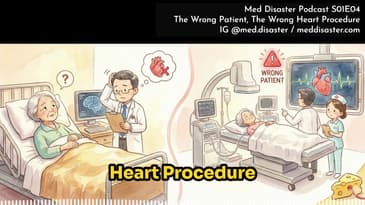
S01E04 The Wrong Patient Wrong Heart Procedure
What happens when the medical staff force you to undergo a procedure you don't want to have?
In this episode of the Med Disaster Podcast, Dr. Sam Rhee delves into a harrowing true story from 2002, where a series of 17 small mistakes at the University of California San Francisco Medical Center led to a 67-year-old woman named Joan Morris undergoing a wrong and potentially life-threatening cardiac electrophysiology study.
Through an intricate timeline and close examination of hospital protocols, the episode explores how similar-sounding names, miscommunications, and procedural oversights converged into a 'never event,' urging a reevaluation of patient safety systems. The incident serves as a stark reminder of the importance of transparency and vigilance in the healthcare system.
#MedDisaster #PatientSafety #MedicalError #HealthcarePodcast
#TrueStories #HospitalStories #MedicalMistakes #PatientAdvocacy #MedicalPodcast #SurgicalSafety #Healthcare
S01E04 The Wrong Patient Wrong Heart Procedure
TRANSCRIPT
[00:00:00] The Wrong Heart Procedure
Imagine waking up in a hospital groggy from a procedure you had yesterday. You're recovering, expecting to go home soon. Then a nurse enters your room and tells you it's time for another test. You protest. You say you don't want it, that you weren't told about it, but the system with its confident nurses and physicians, the clipboards and its schedules, moves you forward anyway.
You're tired, you're confused. You are a patient. You trust them, but what happens when the system is wrong?
Welcome to the Med Disaster Podcast. I'm Dr. Sam Rhee, and today we delve into a shocking, true story of a medical error, a wrong patient procedure, that took place in 2002. This case known as The Wrong Patient Heart Procedure occurred at a major California hospital and reveals how a cascade of small mistakes can lead to a nearly unthinkable outcome.
It is early morning in 2002 at the [00:01:00] University of California San Francisco Medical Center. A 67-year-old patient, Joan Morris, a pseudonym, lies in her hospital bed, recovering from a cerebral aneurysm procedure performed the day before. She's scheduled for discharge later that day after a successful angiography and surgery on her aneurysm.
Unbeknownst to her, another patient, let's call her Jane Morrison, also a pseudonym, is slated for a cardiac electrophysiology study that same morning. The two women have similar last names. As dawn breaks, this coincidence sets the stage for a nightmare scenario of mistaken identity.
This isn't a story about one clumsy mistake or a single incompetent person. This is the story of a system. A story of how at least 17 different seemingly small errors, 17 moments where someone could have stopped the chain of events, aligned perfectly to create what the medical community calls a [00:02:00] never event.
It's a story that helped change the rules for every patient who enters a hospital today. In this episode, we'll explore how this happened, why it happened, and what its legacy tells us about the fragile nature of patient safety.
Meeting Joan Morris and Jane Morrison
To understand how such a profound error could occur, one must first understand the two women at its center. Joan Morris had been admitted to the hospital after a fall and a subsequent MRI revealed two large cerebral aneurysms, dangerous bulges in the blood vessels of her brain.
She underwent a cerebral angiography, a procedure where a catheter is used to visualize the brain's blood vessels. The interventional radiology team successfully treated one of the aneurysms through a process called embolization.
The second aneurysm was deemed better suited for a later surgical admission. Ms. Morris was [00:03:00] stable, her procedure as success and her discharge was planned for the very next day. She was on the road to recovery.
Meanwhile, in another part of the hospital was the patient for whom the cardiac procedure was actually intended. Jane Morrison was a 77-year-old woman with a similar sounding last name. She had been transferred from an outside hospital specifically for an invasive cardiac electrophysiology study.
The first link in a long chain of errors was forged. Following her successful brain procedure, Joan Morris was not returned to her original bed. Instead, to free up a monitored bed for another patient, Joan Morris was transferred to the oncology floor. This decision, seemingly benign and driven by logistical efficiency, was a critical deviation from the expected workflow.
By moving Joan Morris to a different floor, the hospital's bed management team operating in its own silo, [00:04:00] inadvertently created the conditions for the subsequent mixup. It set in motion, a non-standard search for a patient. A search that would prove disastrous.
The procedure at the center of this case was not a simple EKG or routine blood draw. An invasive cardiac electrophysiology study or EP study is a complex and high risk diagnostic test.
It involves threading long, thin, flexible tubes called catheters through a large blood vessel, typically through the groin, and guiding them up into the chambers of the heart. Once inside the heart, specialized electrodes at the tips of these catheters can do two things. They can listen and they can talk.
They listen by recording the heart's intrinsic electrical signals, creating a detailed map of how electricity moves through the cardiac muscle. Then they talk by delivering tiny controlled electrical pulses to the heart tissue.
The purpose of the stimulation is to deliberately provoke the very [00:05:00] abnormal heart rhythms or arrhythmias that the doctors are trying to diagnose. The electrophysiologist is essentially trying to start and stop the heart's irregular rhythm in a controlled environment to pinpoint its origin.
The risks associated with such a procedure are significant. They include bleeding and infection at the catheter insertion site, damage to the blood vessel or even the heart valves, the formation of blood clots that can lead to a heart attack or stroke, and in very rare cases, death.
This is the procedure that Joan Morris, the woman with the brain condition, was about to undergo by mistake. She was not just inconvenienced. She was unknowingly placed in the path of substantial life threatening danger.
The Morning of the Error, a Timeline of Failure
The cascade of errors began early in the morning before the sun had fully risen. At 6:00 AM a nurse from the EP lab telephoned the floor. She was looking for the patient [00:06:00] scheduled for the first procedure of the day.
She asked for patient Morrison. Standard practice even then was moving toward using at least two patient identifiers to confirm identity, such as a full name and date of birth. By only using the last name, the EP lab nurse created uncertainty that the system was not prepared to handle. The staff member answering the phone, mishears or confuses the name and replies, the patient has moved to the oncology floor.
This is incorrect. Jane Morrison, the heart patient, was still in the unit, but Joan Morris, our brain aneurysm patient, had been transferred to the oncology floor for recovery. The phone message gets garbled, and now the electrophysiology nurse believes her patient is on the oncology floor.
Then at 6:15 AM the electrophysiology nurse calls the oncology floor, again asking for patient Morrison. The individual who took this call looks at their patient [00:07:00] roster and saw the name Joan Morris and confused the two similar sounding names. The individual taking the call confirmed the patient was on their floor and would be prepared for transport to the EP lab. The second opportunity to break this chain of error by using a second identifier was missed.
At 6:30 AM Joan Morris's floor nurse, who was nearing the end of her night shift, was asked to take the patient to the EP lab. She reviewed Joan Morris's chart and found no written order for an EP study.
This was a major red flag. The rule in any hospital is clear, no order, no procedure. But instead of stopping the process, the floor nurse made a dangerous assumption. She concluded that the study had been arranged, but that the paperwork simply hadn't caught up yet.
When she went to prepare Ms. Morris for transport, the patient herself became the next line of defense. Joan Morris is [00:08:00] understandably confused when she's woken and told she has an appointment for a heart procedure. She protests that she has no appointment saying, I told my children and I told my doctors I didn't want to do anything else right then. The floor nurse dismissed her patient's direct protest, telling her she could refuse the procedure after she arrives at the EP lab.
This decision effectively deferred a critical safety check and silenced the most important voice in the room. The patients, the nurse perhaps rushing to follow what she thinks are last minute orders, proceeds to wheel Joan Morris to the electrophysiology lab on a gurney.
At 7:00 AM Joan Morris arrives at the EP lab, a procedure room full of monitors, draped equipment, and staff preparing for an invasive heart test. Right away. Joan Morris voices reluctance again. She tells the electrophysiology nurse that she's not aware of any scheduled heart test and she doesn't feel comfortable proceeding.[00:09:00]
Sensing the patient's distress, the nurse pages, the electrophysiology attending physician. The senior cardiologist quickly calls back over the phone, he speaks with a patient who now reports she feels nauseated and unwell and that she never agreed to this test. This attending electrophysiologist who had met and obtained consent from the correct patient, Jane Morrison, the night before, does not recognize on the phone that this Joan Morris is a different person.
The doctor does pause for a moment, just the night before when he had met Jane Morrison, the patient actually slated for the procedure, she had been calm and agreed to proceed. Now he's hearing hesitation and confusion, but the cardiologist dismisses the discrepancy.
He assumes that this Ms. Morrison, who is in reality, Ms. Morris, is simply anxious or has cold feet. He orders an anti-nausea medication and a sedative, compazine, to help her feel better and [00:10:00] notes that the patient has agreed to proceed after their brief conversation.
In truth, Joan Morris is still resisting, but her protests have been effectively overridden by reassurance and mild sedation.
At this point, no one has verified the patient's identity with a full name or ID band. The EP team prepares to start. The electrophysiology nurse does take a look at the chart that came with the patient and she notes something odd. There's no signed consent form on it even though the schedule indicated consent was obtained.
The chart also seems to lack the usual details of a cardiology patient's history. This should have been a glaring warning sign, but instead the team decides to resolve it in-house. The on-call cardiology fellow is asked to handle consent. He comes and presents the form to Ms. Morris, who was tired, confused, sedated, and had already voiced her objections. The consent form she signed details the risks of an EP [00:11:00] study and even mentions the potential need for cardiac surgery to implant a defibrillator, a treatment utterly unrelated to her brain aneurysms. She signed the form, but it was a signature devoid of true informed consent.
Later, Ms. Morris would say she was sedated and extremely groggy and does not even recall signing the form.
In these critical moments, multiple staff members encountered clear deviations from standard procedure, no written order, a protesting patient, a missing consent form. Yet at each turn, they rationalize these anomalies away instead of halting the process. This behavior points to a culture where normalization of deviance has taken hold, where workarounds were accepted to keep things moving.
This was compounded by a clear authority gradient. The patient's protests at the bottom of the hierarchy were easily overruled by a nurse's assumption. That nurses' potential concerns were then implicitly overridden by the momentum of a scheduled procedure that was already in [00:12:00] motion.
The system was not just failing, it was actively pushing the wrong patients toward harm.
The Anatomy of a Never Event
The error is discovered after the procedure begins. Between 7:15 and 7:30 AM Joan Morris is prepped in the lab. Monitoring leads are attached and she's positioned on the procedure table. Another nurse makes casual conversation asking Joan why she's having the heart test.
Joan mentions that she had fainted at some point in the past, and the nurse considers this a plausible reason for an electrophysiology study. Fainting or syncope can indeed prompt such tests and thinks nothing more of it in reality. Joan's fainting episode was related to a brain aneurysm, not a heart rhythm issue, but the staff in the lab aren't familiar with her history.
They accept this explanation and proceed. Around the same time, up on the neurosurgery floor. A neurosurgery resident is doing morning rounds and walks into Joan Morris's room and [00:13:00] finds the bed empty. His patient who had just had brain surgery for her aneurysm is inexplicably gone.
Alarmed, he learns she's been taken down to the EP lab for a heart procedure. Confused and concerned, he rushes down to the lab around 7:30 AM and finds Joan there on the table, instrumented for the procedure.
The resident is upset and demands to know why is my patient here, since no order for any cardiac test had been given to him. The electrophysiology nurse replies that the patient's procedure had been bumped twice already and now she's the first case of the day. In other words, the lab staff just assumed the neurosurgery team wasn't informed of a cardiology add-on.
The neurosurgery resident, likely a junior backs off, and he assumes his attending neurosurgeon must have secretly ordered this test for some reason and not told him. Accepting that explanation, he leaves the lab and another missed opportunity. The resident knew something was off, but his deference to perceived authority [00:14:00] led him to drop his challenge.
At 8:00 AM the electrophysiology attending cardiologist now arrives in person to oversee the case, and by now, Joan Morris's head is draped and only the surgical field is exposed. So the attending never gets a good look at her face. He takes his position at the computer console, just outside the procedure room.
The fellow has already begun the invasive portion. The catheters are threaded into Joan's heart via the femoral vein, and they start the planned program of electrically stimulating the hard to induce arrhythmias. Incredibly this wrong patient procedure is now fully underway and throughout Joan Morris, who never needed this, is now undergoing a risky heart study involving shocking her heart to stop and start it repeatedly to test its electrical system.
At 8:30 AM the system had two more chances to catch itself. A nurse from the floor calls the EP lab to find out why no one has called for the real patient. Jane Morrison. The floor nurse asks [00:15:00] What's going on?
Do you still need to pick up Jane Morrison? Incredibly. After checking with colleagues, the electrophysiology nurse who took the call casually replies at the current case, Joan Morris will be done around 10 and they can send Ms. Morrison. Then the error was still not caught. At the same time, the EP charge nurse, while preparing patient stickers for the day's cases, noticed that the name Joan Morris did not match any of the five names on the morning log.
She entered the procedure room and questioned the fellow. The fellow replies, this is our patient. Because the procedure was at what he described as a technically demanding juncture, the charge nurse did not press the issue, assuming Ms. Morris had just been added to the schedule late.
At 9:00 AM the error was finally discovered, not by anyone inside this flawed process, but by an outsider. The interventional radiologist who had performed Joan Morris's correct procedure the day before [00:16:00] had heard she was taken to the EP lab confused.
He called down to check on her and he asked the question that no one had managed to formulate correctly. Why was his patient Joan Morris, who had just undergone a cerebral aneurysm embolization yesterday, now undergoing a cardiac EP study the EP staff initially respond that the patient on the table is Jane Morrison, that name, they expected.
At this point, the EP attending cardiologist himself says something like, yes, Jane Morrison is here. But the charge nurse overhears and corrects him.
Actually, Joan Morris is on the table right now. There is a moment of stunned silence as everyone in the control room realizes. Now the names are different. The attending cardiologist, eyes widening, asks to see the patient's chart immediately. A quick check confirms the horrific truth.
The wrong patient has been on the table all along. The [00:17:00] procedure was stopped immediately, a full hour after it began. The procedure directly involved in the flawed process had become blind to its errors, a form of tunnel vision. The neurosurgery resident, though he had the correct knowledge, was too low on the authority totem pole to stop the line.
It took a peer from a different service and outsider to the immediate situation to break through their momentum of the mistake. This demonstrates the immense value of cross-disciplinary communication and why a fresh pair of eyes is often one of the most powerful safety tools a hospital possesses the aftermath and the legacy of change.
The EP study was aborted and Joan Morris was returned to her room. She was remarkably in stable condition having just been spared the worst potential outcomes of the unnecessary procedure she had just endured. The cardiology attending and hospital officials go to Joan and her family to explain and apologize for the mistake one can only imagine Joan [00:18:00] Morris's shock unlearning that everything she endured that morning from being woken up to having her heart electrically shocked, was all a terrible mix up.
She ended up spending the night for observation. Recovered and was discharged the next day. The intended patient. Jane Morrison eventually had her electrophysiology test done, presumably with much more vigilance, and gave written, informed.
For Joan Morris. There were no lasting physical injuries, but the incident could have been catastrophic inducing arrhythmias in a patient not properly prepped or indicated for. It carries risks of stroke, cardiac arrests, other complications.
This was a near miss disaster. This could have remained a quiet internal incident, but in an unusual move, this case was selected for publication as a teaching hospital in a major medical journal. This openness was championed by patient safety leaders who wanted the medical community to confront such errors openly.
Who knows [00:19:00] how many of such similar mistakes are occurring in hospitals, but for the secrecy and lack of openness due to fear of bad publicity.
The incident highlighted a major issue in the broader healthcare landscape, the lack of transparency around medical errors. At the time, reporting such sentinel events to the joint Commission. The primary accrediting body for US hospitals was entirely voluntary and as a result, their database only contains 17 reports of wrong patient procedures over the past seven years.
In contrast, New York State, which has a mandatory reporting system, had 27 incidents in just three years. The Joan Morris case became a powerful argument for the idea that voluntary reporting was obviously insufficient to grasp the true nature of the problem and to drive meaningful change.
What's striking in this case is that everyone involved in Joan Morris's case was a trained, well-intentioned professional. As patient safety [00:20:00] advocates have observed, these are good people doing their jobs in a very busy time sensitive and somewhat chaotic environment, which is the modern American hospital. You have many moving pieces.
The story of Joan Morris and Jane Morrison is a chilling reminder that in the complex world of modern medicine, safety is not an accident. It is not the result of just having smart, well-meaning people on staff. Safety is a system. It is a culture.
The 17 errors that led to her unnecessary ordeal were not 17 moments of incompetence. There were 17 symptoms of a system that allowed for ambiguity, prioritize momentum over verification, and failed to listen to the one person who knew for certain that something was wrong.
Joan Morris tried to be her own last line of defense, but the system was not designed to hear her out. The protocols that exist today, the two identifier rule. The mandatory timeout were forged from the lessons of her experience and others like it. They [00:21:00] are designed to force the system to listen, to check, and to pause.
However, these systems are not infallible, and we're left still with a pivotal question. How do we ensure that no patient ever becomes the wrong patient again? Despite all protocols, it ultimately comes down to each clinician, double checking and speaking up.
Even in a hectic hospital with so many moving pieces, think about your own work or experiences, what safety net would catch a similar mistake where you are? The hope is that by learning from cases like Joan Morris's, we can strengthen those nets as clinicians and keep our patients safe.
Thank you for listening to this episode of the Med Disaster Podcast. We would like to hear from you. Please reach out on Instagram at Med Disaster or get more information@www.med disaster.com. Until we scrub into our next episode, please stay vigilant and stay compassionate.