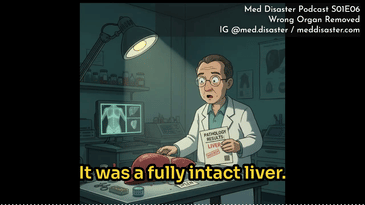
Season One, Episode Six of The Med Disaster Podcast, hosted by Dr. Sam Rhee, recounts the August 2024 death of 70-year-old Navy veteran William Bryan during a planned splenectomy at Ascension Sacred Heart Emerald Coast in Okaloosa County, Florida. After severe left-sided pain and imaging showing a splenic abnormality with blood in the peritoneum, Bryan initially wanted to return to Alabama but agreed to surgery after warnings from surgeon Dr. Thomas Shaknovsky and the hospital’s chief medical officer.
The late-day operation began after Shaknovsky arrived an hour late, encountered poor visibility, bleeding, and a massively distended colon, and converted from laparoscopic to open surgery. Shaknovsky misidentified anatomy, stapled and cut the inferior vena cava, and during the ensuing chaos removed and mislabeled Bryan’s liver as the spleen, insisting it was an enlarged, displaced spleen. Bryan suffered catastrophic hemorrhage and cardiac arrest and was pronounced dead at 7:06 PM. Pathology confirmed the removed organ was a fully intact liver; autopsy found the spleen untouched and no splenic artery aneurysm, confirming death from surgical injury.
The episode describes Beverly Bryan’s account of being given a false explanation, the medical examiner ruling, the family’s legal action, and investigations revealing prior Shaknovsky errors in 2023 (removing part of a pancreas instead of an adrenal gland and a bowel perforation during a gallbladder surgery). It covers Florida’s emergency suspension of Shaknovsky’s license, Alabama’s review, the hospital’s response, and allegations that the hospital was negligent in supervision and credentialing.
The episode compares the case to a 2006 Massachusetts incident where a surgeon removed a kidney instead of a gallbladder and discusses contributing factors such as fatigue, time pressure, poor visualization, cognitive overload, OR hierarchy, and system safeguards, emphasizing surgical checklists, crisis management, institutional accountability, and patient questions about surgeon experience and safety protocols.
#MedDisaster #Surgery #PatientCare #HealthcarePodcast #SurgicalSafety #MedicalError #PodcastLife #ListenNow #TrueStory #truecrime
(This podcast uses AI generated material)
S01E06 Wrong Organ Removed: The William Bryan Case TRANSCRIPT
[00:00:00]
The Med Disaster Podcast, Season One, Episode Six. Wrong Organ Removed, The William Bryan Case.
Hello and welcome to the Med Disaster Podcast. I'm Dr. Sam Rhee and in today's episode, we delve into a shocking surgical error that cost a patient his life and shook the medical community. In August of 2024, 70-year-old William Bryan went into what was supposed to be a routine operation, a procedure to remove a problematic organ, but never came out alive.
The reason? The surgeon removed the wrong organ during the operation. Wrong site surgeries like this are so egregious that they're classified as never events. Errors that should never happen if proper safety protocols are followed. Yet as we have seen and will see again, they do happen. [00:01:00] And the story of William Bryan is a tragic case study in how multiple safety nets can fail.
Today will recount the harrowing narrative of William Bryan's case in detail, his background and how he came to need surgery, the surgical plan and what went wrong in the operating room and how the fatal mistake was discovered.
We will also discuss the immediate aftermath, the investigation, the legal repercussions, and the effect on the family, as well as the broader clinical lessons. Along the way, we'll compare this case to a similar 2006 incident in Massachusetts where a surgeon mistakenly removed an elderly patient's kidney instead of her gallbladder.
We will explore how such wrong organ surgeries occur, examine the surgical safety protocols designed to prevent these errors and identify the system vulnerabilities that [00:02:00] continue to make these tragedies possible. We have direct quotes from those involved findings from investigations and autopsies, and insights from experts on surgical safety.
By the end, we will distill key takeaways about surgical checklists, human factors in the operating room, and accountability at both the institutional and individual levels.
William Bryan was a 70-year-old Navy veteran and retired boilermaker from Muscle Shoals, Alabama. In the summer of 2024, William and his wife of 33 years Beverly, were spending time in Okaloosa County, Florida, where they owned a small rental property.
By all accounts, William was enjoying his retirement and doting on his three children and eight grandchildren. But in mid-August during their stay in Florida, William was suddenly struck with a severe [00:03:00] pain in his left side, specifically his lower left abdomen or flank.
Concerned the Bryans went to their local hospital, Ascension Sacred Heart Emerald Coast to get him checked out. Doctors at the hospital evaluated William and performed imaging scans. The results showed an abnormality in his spleen, possibly an enlarged spleen or some lesion, as well as some blood in his abdominal cavity, also known as peritoneum, though without active bleeding.
In other words, something was wrong with his spleen that might have been causing internal bleeding. The working diagnosis was serious enough that the medical team recommended an immediate splenectomy, which is a surgery to remove the spleen.
At this point, William and Beverly were understandably anxious. This recommendation caught them by surprise. They were away from home, and now William was being told he [00:04:00] needed major surgery. The couple initially hesitated and even refused the surgery when it was first suggested. And William expressed that he preferred to wait and be treated back home in Alabama by his own doctors.
Understandably, undergoing, a significant procedure like a splenectomy in an unfamiliar hospital far from home, gave them pause. The hospital staff admitted William Bryan for observation and non-surgical management at first, hoping perhaps the issue could be managed conservatively.
However, over the next several days, the surgeon caring for William, a general surgeon named Dr. Thomas Shaknovsky, grew increasingly insistent that surgery was necessary sooner rather than later.
According to later investigations, Dr. Shaknovsky and even the hospital's chief medical officer personally spoke with the Bryans to [00:05:00] persuade them that waiting was too dangerous.
They warned that William could experience serious complications if he left the hospital without surgery.
They pointed to lab results including a mildly dropping hemoglobin level as evidence that the spleen might be leaking or his condition was worsening.
Faced with these warnings, William reluctantly agreed on the third day of admission to go ahead with the operation at that Florida hospital. This would prove to be a fateful decision. The plan was for a hand assisted laparoscopic splenectomy on August 21st, 2024.
In a hand assisted laparoscopy, the surgeon operates with laparoscopic instruments, but also makes a small incision to insert a hand for guidance. The spleen is located on the upper left side of the [00:06:00] abdomen, just under the rib cage. Removing it laparoscopically can be challenging, especially if it's enlarged or if there's bleeding, but it's a common procedure in general surgery.
Still, it's worth noting that Ascension Sacred Heart Emerald Coast, was not a major tertiary medical center. The OR staff later commented that splenectomies were not performed there regularly. Some nurses and techs on the team even voiced concern before the surgery that doing a complex case late in the day, it was scheduled for 4:00 PM with a skeletal evening crew, and with Dr. Schakowsky's level of experience, it could be risky. Unfortunately, those concerns, did not stop the case from proceeding.
On August 21st, 2024, William Bryan was brought to the operating room for a [00:07:00] splenectomy.
Dr. Shaknovsky arrived about an hour late and the surgery did not get underway until about 5:20 PM. By that time, as predicted, only a limited OR team was on duty.
After the surgical timeout and after induction of general anesthesia, Dr. Shaknovsky began the operation laparoscopically. Small incisions were made in William Bryan's abdomen for a camera, and instruments, and insufflation gas inflated the abdominal cavity to provide working space.
Initially, things did not go smoothly. The surgical team encountered poor visibility almost immediately.
William Brian's abdomen was distended with blood and his intestines were swollen. In fact, he had what was later described as a megacolon, which is a massively distended colon that sprang into [00:08:00] view, once the abdomen was open. With active bleeding obscuring the field, and possibly due to the colonic swelling, Dr. Shaknovsky decided to convert from a laparoscopic approach to a full open surgery, which is a common decision when anatomy or visualization is difficult.
Now performing an open splenectomy through a large incision, Dr. Shaknovsky attempted to locate and isolate the spleen. He would later write in his operative report that he had identified the spleen and was methodically dissecting its attachments. Ligaments, such as the gastrosplenic ligament and the splenorenal ligament, and that the spleen was large and quite friable, meaning easily crumbled.
He claimed it was so enlarged that the spleen became quite mobile after he [00:09:00] freed it from the surrounding structures. However, this orderly appearing narrative in his report did not match the reality witnessed by others in the operating room. In truth, the scene was growing chaotic. The massive colon and the ongoing bleeding made it extremely hard to discern anatomy.
The assisting staff tried their best. They retracted the distended colon out of the way, and they suctioned blood as fast as they could. At this point, everyone in the room knew that this was a dangerous situation. A splenectomy can become a crisis if bleeding isn't controlled because the spleen is vascular.
But unbeknownst to them, the worst was yet to come.
As he probed inside the crowded abdomen. Dr. Shaknovsky misidentified a major anatomical structure. He palpated [00:10:00] a large blood vessel and even remarked to the nurse assisting him quote, that is scary, feeling a strong pulse under his finger.
This comment suggests that he knew he was dealing with something significant, likely the abdominal aorta or the inferior vena cava IVC, the huge vein that carries blood from the lower body up into the heart. Nevertheless, he proceeded. Dr. Shaknovsky applied a surgical stapling device around this vessel and fired the stapler.
In an instant, catastrophe struck as soon as the stapler cut and closed the vessel, an uncontrollable hemorrhage erupted. William Bryan's blood poured out by the liter and his blood pressure plummeted. He went into cardiac arrest on the table almost immediately as his circulatory system collapsed. [00:11:00] The OR staff sprang into action.
The anesthesia provider called a code blue. Extra personnel rushed in chest compressions were started, and massive transfusion protocols were initiated to try to replace William's blood volume. Okay. In the middle of this chaos with the patient, technically in cardiac arrest, Dr. Shaknovsky did something extraordinary and not in a good way. Instead of stepping back or attempting damage control, he continued surgery blindly dissecting in a pool of blood inside the abdomen. He did not request additional clamps or devices to control bleeding. He simply kept cutting. At one point, he again fired the stapler into an indistinct mass of tissue without any visual clarity.
Finally, Dr. Shaknovsky [00:12:00] removed a large organ from the abdominal cavity and set it on the operating table announcing he had removed the spleen. The organ was immense.
It measured about nine by seven by four and a half inches, and weighed over 4.6 pounds. To put that into perspective, a normal spleen weighs at most four tenths of a pound, and even a severely enlarged spleen will weigh under a pound. In fact, it was not a spleen at all. It was William Bryan's entire liver. For a brief moment, there was stunned silence in the operating room.
The surgical staff stared at the organ on the table. It was clearly a liver, the vital organ that occupies the upper right quadrant of the abdomen, recognizable by its smooth, large, red brown [00:13:00] appearance. The spleen, by contrast, is a much smaller purplish organ normally tucked up on the left side.
As one might imagine, the realization hit like a ton of bricks. One operating room staff member later said they felt sick to their stomach, just seeing the liver lying there knowing what had happened.
Yet astonishingly, Dr. Shaknovsky insisted that this organ was the spleen. He told the team words to the effect of, this is the spleen, it was just massively enlarged and out of place, and he directed them to label the specimen as spleen for pathology.
The OR staff exchanged uneasy glances. They knew it was not a spleen. But in the hierarchy of the OR, challenging the lead surgeon in the heat of the moment can be difficult. And under his [00:14:00] orders, a staff member reluctantly tagged this removed organ as the spleen, despite knowing it was the liver.
Meanwhile, attempts to resuscitate William Bryan were failing. After 15 to 20 minutes of CPR, massive transfusions and efforts to repair the damage, the team could not get his heart beating effectively again. The blood loss was too sudden and too severe, and William Bryan was pronounced dead on the operating table at 7:06 PM and he never regained consciousness. What was supposed to be a straightforward organ removal had turned into an unthinkable disaster.
In the immediate aftermath of the code, the operating room was in disarray. William Bryan's lifeless body lay on the table. Dr. Shaknovsky, perhaps in shock himself, stepped [00:15:00] out of the OR once the time of death was called. But notably, he did return to the operating room at least three separate times in the minutes that followed.
Each time he repeated a false narrative to the remaining staff. He asserted that a ruptured splenic artery aneurysm had caused an unforeseen bleed, which is what led to the patient's death. In other words, he was already trying to reframe the event as a rare surgical complication, an aneurysm of the splenic artery that burst and caused fatal bleeding rather than a human error.
The staff found this very unsettling as it did not match what they had witnessed. Dr. Shaknovsky seemed to be attempting to convince his colleagues that this version was the truth, essentially covering up the mistake in real time. On his third trip back to the operating room, Dr. Shaknovsky [00:16:00] asked if anyone had measured the spleen he had removed.
No one had, so presumably the giant organ was measured at that point. He then requested to personally go to the pathology lab to view the specimen and even at this juncture, after having had a moment to collect himself, Shaknovsky later claimed that he still thought it was the spleen when he went to pathology. If true, it indicates a profound level of anatomical confusion or denial. In reality, the truth could not be hidden for long.
Pathologic examination of the organ which had been mislabeled spleen revealed the obvious. It was a fully intact liver. The pathologist report confirming this came out shortly after the surgery. Further, an autopsy was performed on William Bryan's body, given the unusual circumstances of his death on the OR table, and the medical [00:17:00] examiner conducting the autopsy found that William's spleen was still inside his body completely untouched and in its normal anatomic position.
The entire liver was missing, of course, and they noted that the inferior vena cava, the large vein, had been stapled and cut. There was no evidence of any ruptured aneurysm of the splenic artery or of any other vessel. The bleeding had clearly come from the massive tear in the inferior vena cava and the liver removal.
Essentially, the autopsy confirmed what the OR staff feared. The cause of death was a grievous surgical error, not an act of God or unpredictable complication.
Beverly Bryan, the widow, learned of her husband's death and soon after the truth of what had occurred. [00:18:00] Initially, she was told a distorted story. Dr. Shaknovsky talked to her after the operation and stuck to his false explanation. He told Beverly that William's spleen was terribly diseased and four times bigger than usual and had migrated to the other side of the body, which is why things went wrong. And one can only imagine Beverly's confusion hearing that rationale.
As her attorney later noted with incredulity, typical human anatomy dictates that the liver and spleen are on opposite sides of the abdomen and are vastly different in size. The notion of a spleen moving to the right side and enlarging to the size of a liver defies reality and is a desperate lie.
Beverly was also informed, presumably by hospital staff once the pathology came in, that in fact, William's spleen, the organ that was supposed to be removed, [00:19:00] was inside him still and only had a small, benign cyst. The true cause of his death was now clear to her. This revelation was devastating. What was meant to be a careful operation to help her husband had instead killed him in a senseless way.
As Beverly later put it in a public statement, my husband died while helpless on the operating room table by Dr. Shaknovsky. I don't want anyone else to die due to his incompetence. She described William, essentially as a homicide victim on the operating table.
Indeed, the Florida Medical Examiner ruled the death to be caused by the surgical injury. Some might say this negligence rises to the level of a criminal act in such an egregious case. And Beverly, grief stricken and angry was determined to seek justice.
Within weeks, Beverly Bryan hired a law firm to investigate and pursue legal [00:20:00] action. The emerging picture of Dr. Shaknovsky was alarming.
Through lawyers and subsequent media investigations, Beverly and the public learned that this was not the first serious surgical mistake on his record. In May of 2023, Dr. Shaknovsky had performed a surgery on a 58-year-old man to remove an adrenal gland tumor, but he mistakenly removed a portion of the patient's pancreas instead, never actually taking out the adrenal gland.
That patient was left permanently harmed by the unnecessary pancreas resection.
Astonishingly. Shaknovsky also tried to explain away that error by claiming the patient's adrenal gland had migrated to an unusual location in the body, a foreshadowing of the excuse he would use again with William Bryan. That 2023 mistake was quietly settled and did not [00:21:00] immediately cost Shaknovsky his career.
He continued to practice. Additionally, there were reports in July of 2023, during a routine gallbladder removal, Shaknovsky had accidentally perforated a patient's intestine causing sepsis and went on a leave of absence thereafter.
In short, Williams' case was part of a pattern of major errors. It appears the regulatory and hospital systems had not intervened decisively after the earlier incidents setting the stage for this fatal outcome.
As the gruesome details became public, the regulatory authorities finally took action. Florida's Surgeon General issued an emergency suspension order on Dr. Shaknovsky's medical license, effectively barring him from practicing pending further investigation.
The suspension order lambasted his repeated egregious surgical errors, and noted that his [00:22:00] continued practice presented an immediate, serious danger to the health, welfare, and safety of the public. The State of Alabama, where he also held a license, launched its own disciplinary review as well.
The hospital Ascension Sacred Heart Emerald Coast responded with public statements of sympathy and promises to investigate, stating they took allegations like this very seriously, and their leadership was performing a thorough investigation. They offered thoughts and prayers to the family, but cited patient privacy and ongoing litigation as reasons they couldn't comment further.
They removed Dr. Shaknovsky's profile and photo from the website and reportedly cut ties with him. Nonetheless, questions remained about the hospital's role and potential liability. The widow's lawsuit not only targets Dr. Shaknovsky, but alleges that the hospital administration [00:23:00] tried to cover up the error or was negligent in credentialing and supervising the surgeon.
At the time of this recording the lawsuit is ongoing and it will likely bring out more details about what went wrong at a system level.
William Bryan tragically lost his life just two days before what would have been his 34th wedding anniversary.
His case stands as one of the most dramatic wrong organ errors on record, but it is not an isolated incident. To understand how this could happen, we can look at similar cases and examine the common breakdowns in safety protocols.
William Bryan's case echoes another notorious surgical error that took place in Massachusetts in 2006. In that incident, instead of mistaking a liver for a spleen, a surgeon mistook a kidney for a gallbladder.
The patient was an 84-year-old woman who was supposed to have a [00:24:00] laparoscopic cholecystectomy, removal of her gallbladder, at Milford Regional Medical Center.
The attending surgeon, Dr. Patrick McEnaney. He encountered a lot of inflammation and bleeding around the gallbladder area during the laparoscopy. He decided to convert to an open surgery and performed a cholangiogram, which is an intraoperative x-ray test to identify bile ducts to make sure he was in the right spot.
Unfortunately, he misinterpreted the cholangiogram and became disoriented about the anatomy, and believing he had found the cystic duct, which leads to the gallbladder, Dr. McEnaney actually instead had gotten into part of the kidney's collecting system or was otherwise confused by the inflamed tissues.
He proceeded to remove what he thought was the diseased gallbladder, but was in fact the patient's right kidney. By the [00:25:00] time the organ was removed, it was so badly damaged from surgical dissection and cauterization that it was unrecognizable to the naked eye.
The surgical team did not recognize the mistake during the operation. The patient did survive the surgery and ironically, her condition improved afterward to the point where she did not even need a gallbladder removal anymore. Perhaps her initial pain had been coming from a transient gallbladder attack that settled, or the stress response and medications around surgery alleviated her symptoms.
The horrific error came to light a few days later when the hospital pathologist examined the removed tissue and reported it was kidney tissue, not gallbladder.
The fallout in that 2006 case was significant, but not career ending. The Medical Board of Registration and Medicine temporarily suspended Dr. McEnaney's medical license about six months later, but then stayed the suspension, meaning it did not go [00:26:00] into effect as long as the surgeon agreed to a strict probation for five years.
His probation terms required that another experienced surgeon be present as a proctor whenever he operated to monitor and hopefully prevent any repeat mistakes.
Dr. McEnaney had no prior history of mistakes and was otherwise well regarded, so the board treated it as a serious lapse, but not one warranting a permanent ban.
In fact, a board spokesman, made a rather frank statement to the press. The truth of the matter is that medical errors do occur. Oftentimes it doesn't do anyone any good to remove a physician from practice if he is otherwise a good physician.
The quote illustrates the regulatory mindset that one significant error if deemed truly accidental and remediable, might be addressed with supervision and retraining rather than ending a surgeon's career.
This [00:27:00] Massachusetts case highlights a few key points that resonates with William Bryan's case. A difficult intraoperative situation, inflammation, abnormal anatomy or poor visibility, misidentifying anatomy in William Bryan's case. And the delay in recognizing the error until after the fact.
Let's analyze what typically goes wrong and how these tragedies should be prevented.
Fatigue, time pressure, cognitive overload, and stress can all contribute to errors. William's surgery started late in the day under suboptimal conditions. The surgeon was reportedly an hour late, possibly rushing.
The operating room staffing was lean, maybe tired or unprepared for such an extensive case. When the bleeding started and the colon popped out, that may have created high stress and possibly some panic.
Under those [00:28:00] circumstances, cognitive function narrows. It's a known phenomenon that people can become task focused or even tunnel visioned in a crisis.
A principle of crisis management in the OR is slow down to speed up. Take a moment, get help, and don't make things worse by scrambling around without clarity. Unfortunately, Dr. Shaknovsky did the opposite. He doubled down and kept cutting in a panic.
A more composed surgeon or one with backup present might have converted the procedure into a damage control mode. Pack the area, call for vascular surgery help rather than continuing to remove a spleen that was no longer the priority.
Competency and credentialing is a systems issue. Should Dr. Shaknovsky have been performing that splenectomy at that hospital? The OR team had doubts about his skill [00:29:00] level for it. He had also had recent prior complications. Why did the hospital allow him to proceed unsupervised? In hindsight, at least it appears to be a grave oversight.
Compare this to the Massachusetts case. After a single error, that surgeon was required to have a co-surgeon monitor him for years. If a similar restriction had been placed on Dr. Shaknovsky after his pancreas incident, perhaps a second surgeon in William Bryan's case would've intervened or not let the error go that far. There is an onus on hospital peer review committees to identify surgeons who are struggling or who have had serious near misses and either retrain, proctor, or suspend them as needed.
Either the Florida hospital was unaware of the earlier settled case, or it did not act decisively.
The fact that a hospital executive was involved in convincing the patient to have the surgery [00:30:00] there suggests that the institution might have been keen on doing the case, perhaps not recognizing the risk of letting this particular surgeon handle it. This speaks to institutional accountability.
As we conclude the story of William Bryan's death serves as a grim reminder of what can go wrong when multiple layers of safety fail. Here is a patient that did everything right.
He sought help for his pain. He trusted the doctor's advice. And he consented to a surgery that should have saved or at least improved his life. Instead, a cascade of errors turned that operating room into a lethal environment. Misjudgment. Removing a liver instead of a spleen was the final fatal act.
Behind that, there were systemic issues, perhaps inadequate vetting and oversight of the surgeon, possible lapses in team communication and deviation from fundamental [00:31:00] surgical principles. This case is a sobering study in cognitive error and confirmation bias.
It underlines the importance of humility and vigilance and surgery. We must always be willing to consider, should I be doing something differently, especially when the stakes are literally life and death on the table.
For the patients and the public. William Bryan's story may understandably shake confidence, but it's also a rallying cry for better safety practices.
Never underestimate a minor safety step. If something seems off, pause the procedure. A competent surgical team functions with shared situational awareness.
Institutions must act decisively on warning signs. One malpractice claim or surgical complication may be bad luck, but multiple ones demand intervention.
Patients and families should be empowered to ask questions too. It is okay to [00:32:00] ask your surgeon, how often have you done this procedure? Will anyone else be involved? What protocols are in place to prevent errors? Good providers will welcome these questions and an engaged patient is always an additional layer of protection.
Ultimately, the goal is so that tragedies like this become so unthinkably rare that they truly do never happen again.
Thank you for listening to this episode of the Med Disaster Podcast. I'm Dr. Sam Rhee, and we would like to hear from you. Please reach out on Instagram @Med.Disaster or follow us at www.meddisaster.com.
Until we scrub into our next episode, please stay vigilant and stay compassionate. Thank you.